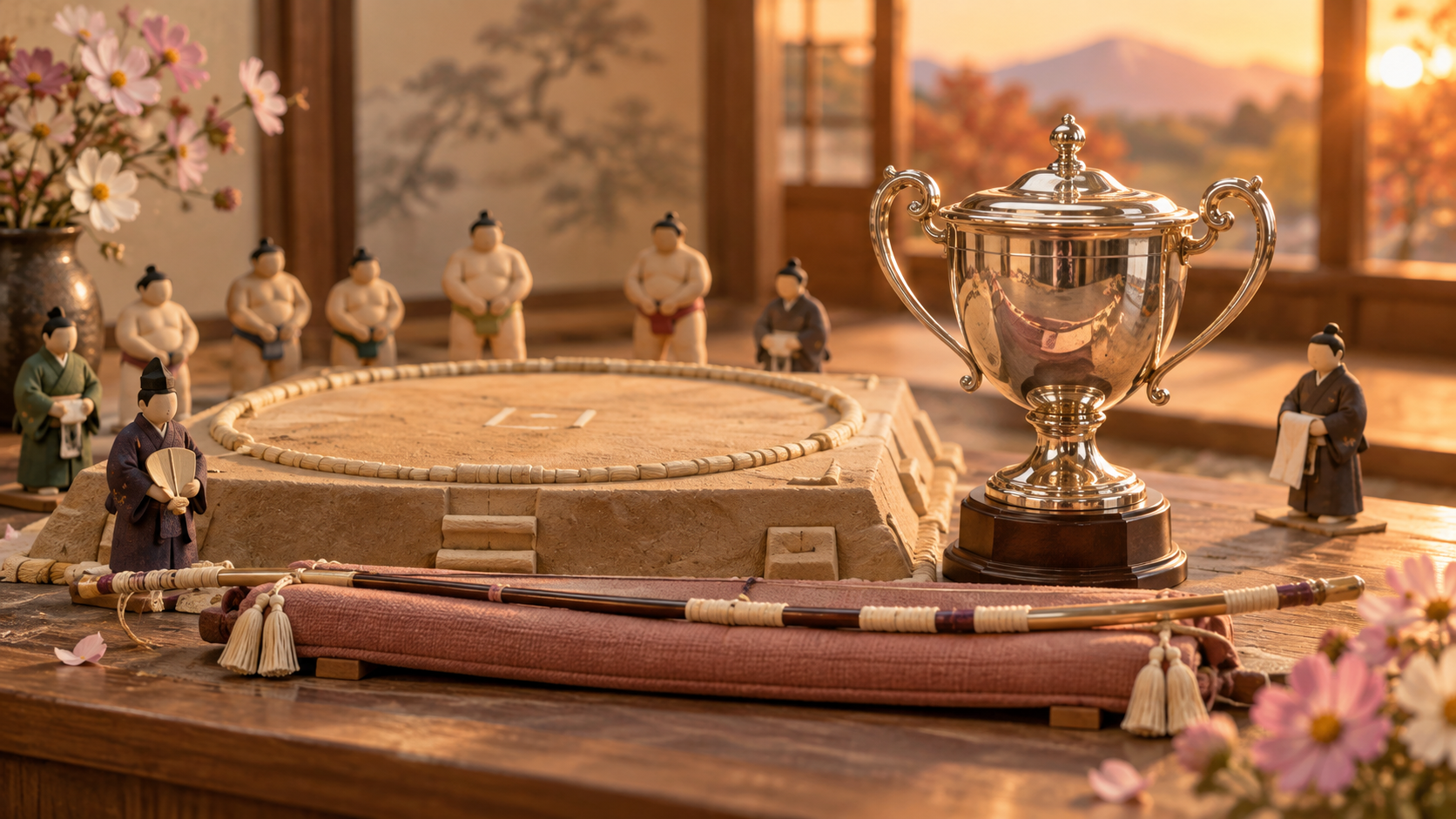
Senshuraku is the fifteenth and final day of a grand sumo tournament. Alongside the regular bouts, it brings an Association greeting, the ceremonial stamping before the final three makuuchi contests, the bow-twirling ceremony and the awards. A championship playoff is added if the best record is tied. If you book onward travel for the moment the final scheduled bout ends, you may leave before the day gives its full answer.
The word *senshuraku* has the feeling of a theatre curtain coming down. Yet sumo’s final day does not simply become quieter and stop. Fifteen days of results are converted into rituals, prizes and the first questions about the next banzuke.
There is an official greeting
The Japan Sumo Association’s Tokyo day guide says that on both opening day and senshuraku, the Association chair enters the dohyo with wrestlers ranked sanyaku and above to greet the audience. The final day’s distinctive programme is therefore not confined to the last minutes.
The exact running and finishing times are unknown in advance. The official page itself labels times as approximate, and bouts, ceremonies and venue operation can move them. Treat an old timetable as background only, then check the official page for the tournament and day you will actually attend.
*Koreyori sanyaku* means the final three bouts
The Association’s 2025 explainer says that *koreyori sanyaku* identifies the three remaining contests, including the final bout, and that the six wrestlers—three from each side—step onto the dohyo for the *sanyaku soroibumi*. That establishes the general ritual, not the names or exact timing at the tournament you attend.
Here, “sanyaku” does not mean that every participant necessarily holds the rank of sekiwake or komusubi. Calling the six stamps a physical clock—only three contests remain—is our viewing metaphor, not an official interpretation of the rite.
The final scheduled bout is not the final ceremony
After the concluding bout comes the bow-twirling ceremony. A designated wrestler handles the bow on behalf of the winner of the last contest. The Sumo Museum traces the ceremony to an earlier practice in which a winning wrestler received a bow and performed with it.
On senshuraku, the awards then follow. The makuuchi champion receives the Emperor’s Cup and championship flag. The Association’s guide also lists the three special prizes—Outstanding Performance, Fighting Spirit and Technique—for eligible wrestlers ranked sekiwake and below.
You may choose to leave earlier because of fatigue or transport. That is a practical decision, not bad fandom. But if “see the final day to its end” is the goal, do not tie a reserved train or dinner booking tightly to the final bout.
A playoff is possible, not guaranteed
If one wrestler has the best record after the regulation bouts, there is no need for a championship playoff. If the best record is shared, a playoff decides the champion. The Association’s explainer notes that the gyoji officiating a makuuchi playoff is chosen at the rank grade appropriate to the wrestlers involved.
A senshuraku ticket does not promise a playoff. Whether one is needed remains unknown until the regulation results show a tie for the best record. If it occurs, it is a competition needed to decide the championship, but the safe plan says “possible,” not “expected.”
Do not infer a wrestler’s feelings, injury or intent from one bout, one expression or the position in the final-day order. The official result establishes the recorded outcome; an inner state remains unknown unless an attributable primary statement addresses it.
Leave a buffer and follow one record
Our recommendation is to check the official day information and leave room in the return journey after the approximate end. Then choose one wrestler before you arrive and know his record. A final win can change the questions you carry into the next banzuke, but this article does not predict a rank or prize.
If the day runs late or your body or return connection says “go,” leaving early is the fallback, not failed fandom. Move to the safe journey you prepared and use the official results to catch up on what you missed.
If you cannot hear an announcement or see a ceremony clearly, use the arena or programme display and the official result as the sensory alternative. Ask venue staff about an essential movement or safety instruction; do not depend on this article for same-day accessibility arrangements.
When the six wrestlers stamp before the last three bouts, that one person’s fifteen-day story is closing too. Senshuraku is not only an ending. It is the day you begin waiting for the next banzuke.
Sources
- Japan Sumo Association, “A tournament day in Tokyo,” quiz No.1249, quiz No.1121, and Sumo Museum “Tournament Prizes” material (verified 4 September 2026).
Source links used for verification
Each link was used for the corresponding claim in this article; inclusion is not a blanket endorsement of the whole page.
Article verified:
- Japan Sumo Association: A tournament day in TokyoPrimary source (as checked for this article)
- Japan Sumo Association quiz No.1249: koreyori sanyakuHistorical primary source (record from that period)
- Japan Sumo Association quiz No.1121: championship playoffsHistorical primary source (record from that period)
- Japan Sumo Association Sumo Museum: tournament prizesHistorical primary source (record from that period)