Sandan-gamae is an old-form ritual in which the two highest-ranked wrestlers demonstrate three fundamental states of sumo. The Japan Sumo Association identifies the upper posture as the natural or original body, the middle as the attacking body and the lower as the defensive body. You should not expect all three during an ordinary tournament day’s programme. A compressed trace is easier to find: in the juryo and makuuchi ring entrance, the wrestlers’ slight lift of the kesho-mawashi is said to abbreviate sandan-gamae.
The name can suggest three increasingly deep squats. The official explanation offers something much more intriguing. These are not merely heights but a miniature grammar of a contest: a body before it has chosen, a body that attacks and a body that defends. Even more surprising, a rare formal demonstration survives in everyday viewing as a tiny movement of two hands and an apron.
Detailed description of this diagram
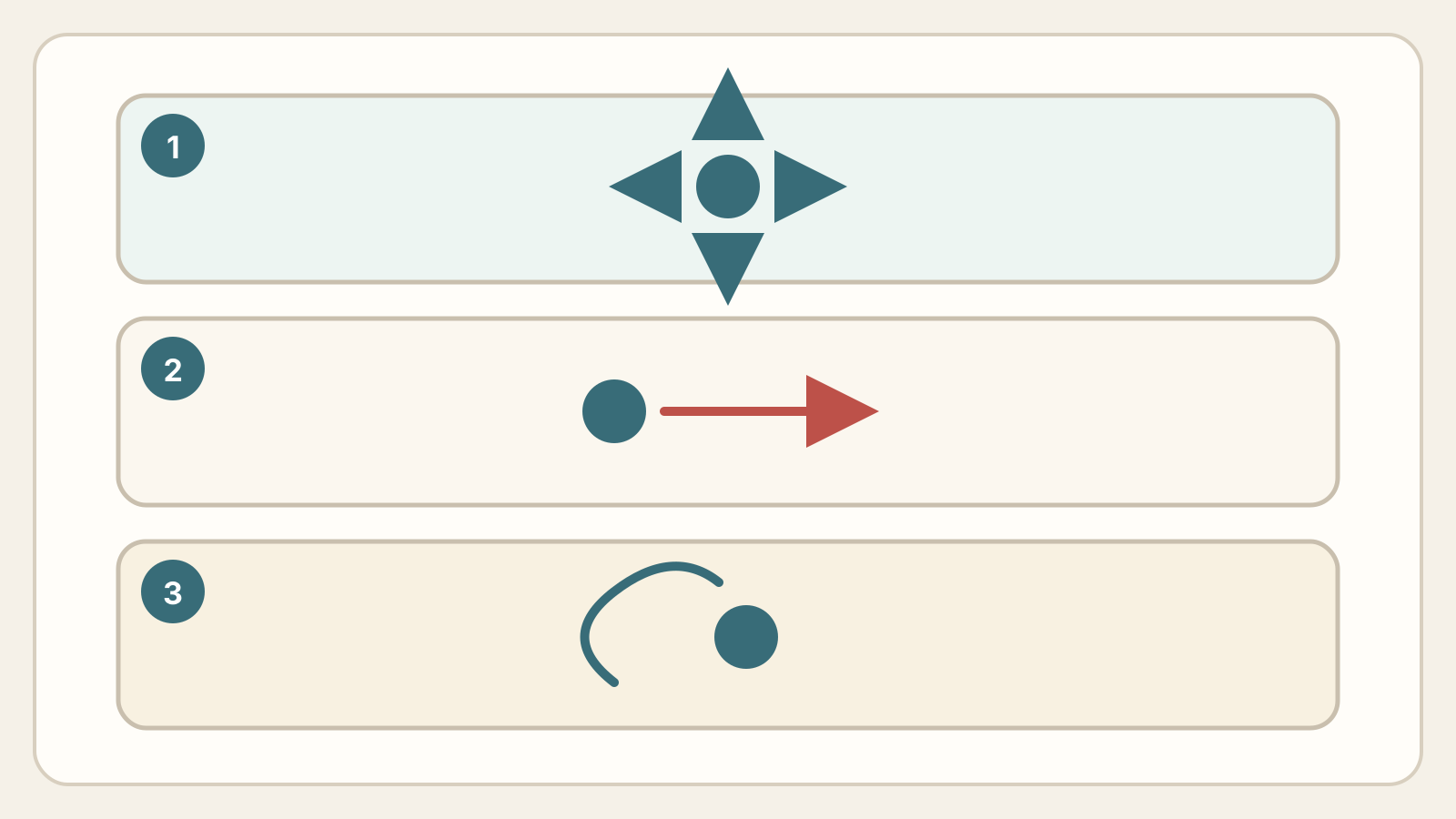
Read three equal cards from top to bottom. The first uses a central point with balanced lines in four directions for the natural or original state. The second sends an arrow forward from one point for attack. The third places a point inside an open arc for defence. Equal symbol size avoids ranking one state above another; vertical placement is only reading order, not centre-of-mass or body height. No person, limb, joint angle, stance width, motion, speed, paired spacing, costume, named wrestler, training model or certain origin date is shown.
Graphic: SUMO ARCHAEOLOGY CLUB · Figure source 1 · Figure source 2 · Figure source 3
Three postures, three states
The Association presents the set this way:
| Posture | State in the official explanation | |—|—| | Upper | *Honnen no tai*, the natural or original body | | Middle | The attacking body | | Lower | The defensive body |
“Upper” should not be read as first place, nor “lower” as inferior. The three belong together. *Honnen* is the hardest term to compress into English; “natural” or “original” body conveys the idea of a state not yet committed entirely to attack or defence, but it is worth retaining the Japanese term rather than pretending one translation exhausts it.
It is not the routine crouch before every bout
Sandan-gamae is a formal rite demonstrated by two wrestlers at the highest rank, according to the Association. It is not another name for the repeated shikiri at the white lines, and it is not a daily item for which a first-time visitor should search the standard arena timetable.
The Association’s quiz pages use a performance by Hakuho and Kisenosato at the event titled Grand Sumo beyond 2020 as a modern visual example. If you encounter official footage or another special demonstration, follow the symmetry first: two bodies matching each other as the form moves through uncommitted, attacking and defensive states.
Keep “said to” attached to the origin
The Association says the rite is traditionally attributed to the 23rd Yoshida Oikaze, who is said to have devised it and transmitted it to the 19th yokozuna Hitachiyama and 20th yokozuna Umegatani. The wording contains a qualification, and this article keeps it.
Inherited ceremonies reach the present through texts, performances and later explanations. A neat origin story is tempting, but removing “said to” would turn a transmitted account into stronger documentary certainty than the selected source offers. The open edge is not a flaw; it is where further historical research can begin.
A miniature survives in the division ring entrance
Once the juryo or makuuchi wrestlers form their circle, they perform a short group sequence. The Association describes the single clap and raised right hand as abbreviated chiri-chozu, the slight lift of the kesho-mawashi with both hands as abbreviated sandan-gamae, and the final raising of both hands as abbreviated shiko.
That lift is not a complete performance of the three postures. It is a compressed reference. Yet it means a viewer can meet the name on an ordinary tournament day without falsely labelling every pre-bout crouch. The centre panel of an ornate apron briefly becomes a bookmark pointing to a much rarer rite.
One detail for the next ring entrance
Trying to photograph every kesho-mawashi almost guarantees that the common gesture will finish while you are framing the designs. Choose one wrestler. After the clap, watch where both hands meet the apron and notice the small upward movement before the arms change position again.
You may never see a full sandan-gamae in person. Its outline has not vanished, however. Two hands under embroidered silk carry a thread toward the three old states of sumo. Once you know that, the division ring entrance can look less like a costume parade and more like a moving archive that opens for only a few seconds.
Sources
- Japan Sumo Association, Grand Sumo Quiz Nos. 775, 904, 356 and 912 (accessed September 2, 2026)
Source links used for verification
Each link was used for the corresponding claim in this article; inclusion is not a blanket endorsement of the whole page.
Article verified:
- Japan Sumo Association Grand Sumo Quiz No.775: the upper sandan-gamae posturePrimary source (as checked for this article)
- Japan Sumo Association Grand Sumo Quiz No.904: the lower sandan-gamae posturePrimary source (as checked for this article)
- Japan Sumo Association Grand Sumo Quiz No.356: sandan-gamae and its transmitted originHistorical primary source (record from that period)
- Japan Sumo Association Grand Sumo Quiz No.912: sandan-gamae compressed in the ring entrancePrimary source (as checked for this article)