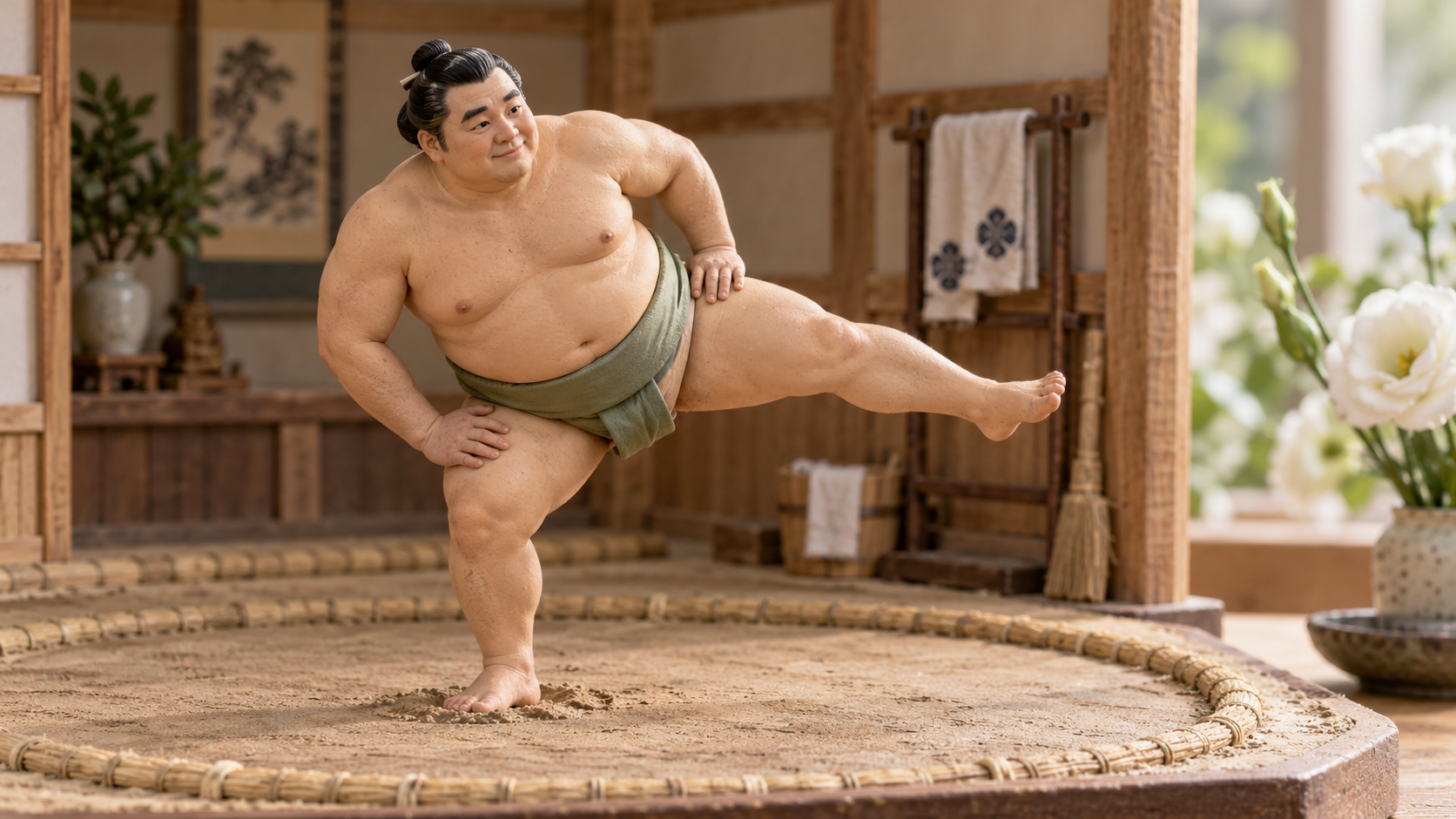
Shiko is a fundamental sumo movement: the wrestler transfers his weight to one side, straightens the supporting leg and lifts the other leg together with his body before bringing it down. The Japan Sumo Association also explains the stomp as driving harmful energy into the earth. Next time, resist watching only the spectacular raised foot. Follow the opposite knee as it extends and sends the whole body upward.
The airborne leg owns most photographs of shiko. Yet an official Association coaching report describes the movement through the leg that stays on the ground. That small reversal changes the reading: shiko stops looking like a flexible man’s high kick and becomes an exact piece of weight transfer carried by one quiet support.
Detailed description of this diagram
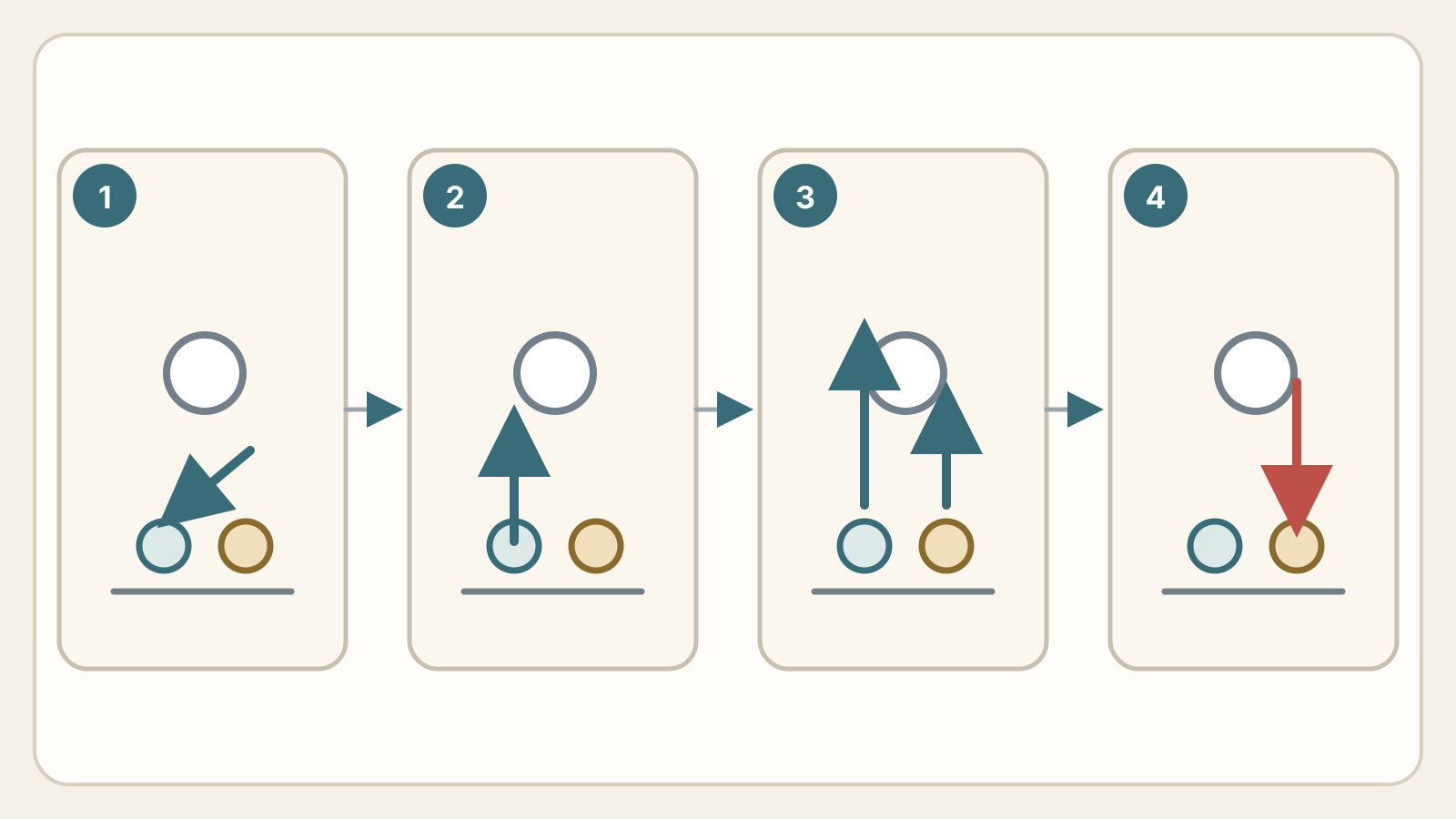
Four cards track three non-body tokens. Two lower tokens are possible supports and one upper circle is the whole-body state. Card 1 moves a weight arrow to one side. Card 2 lengthens that side's support line. Card 3 raises the upper circle and opposite-side dot with matching arrows. Card 4 returns the free-side dot to the ground line. Tokens are not feet, legs or a wrestler and cannot teach the movement. Leg height, joint angles, stance width, speed, force, sound, repetitions, flexibility, fitness, injury, quality ranking and ritual efficacy are not encoded.
Graphic: SUMO ARCHAEOLOGY CLUB · Figure source 1 · Figure source 2
The movement begins on the ground
In its photo report from a children’s stable open day, the Association describes shiko as shifting the body weight, extending the supporting leg and raising the other leg together with the body. The free leg is therefore not an isolated limb being swung as high as possible. The base, hips and lifted side participate in one connected motion.
Arena spectators cannot diagnose muscles or technique from a distant view. Follow an observable sequence instead: the support knee extends, the level of the hips changes, and the opposite leg travels with the torso before returning. The “before” of the stomp becomes as interesting as the sound after it.
A ritual meaning as well as a basic exercise
An Association quiz says that shiko carries the meaning of driving harmful or impure energy down into the earth. This is a ritual explanation transmitted within sumo, not a scoring rule. The source does not say that a higher leg or louder landing purifies the dohyo more effectively.
What we can verify here is the interpretation the Association presents today. These sources do not date its origin or prove that every period and community held only that explanation. We therefore separate the current movement instruction from the ritual account and do not call either a complete, exclusive origin story. A fuller history would need older training manuals, records of sumo custom and other contemporary evidence.
That distinction matters. It keeps us from ranking wrestlers by a dramatic freeze-frame or turning a cultural gesture into a pseudo-scientific measurement. The Association describes a ritual meaning for shiko, but the selected sources do not establish a direct historical or procedural link to dohyo-matsuri. Observe the point of contact without converting volume or height into a measure of purification.
Shiko belongs to practice and ceremony
Wrestlers repeat shiko as a basic movement in training. The Association also uses the word when explaining ring-entry gestures. Physical preparation and a ritual meaning coexist rather than cancelling each other, but this paragraph does not fix the form or count used in every ceremony.
This article is intentionally not a fitness programme. A professional’s range, balance and repetition were built under instruction. Do not infer that copying the maximum height from a photograph is safe or beneficial for every body. At a stable visit or organised experience, follow the host’s rules and coaching rather than improvising from the audience.
Where did the stomp go in the makuuchi ring entrance?
During a juryo or makuuchi division ring entrance, the assembled wrestlers complete a compact series: a clap, the right hand raised, a slight lift of the kesho-mawashi, and both hands raised. The Association describes the final raising of the hands as an abbreviated form of shiko. It also says that wrestlers once performed an actual stomp in the group ceremony.
This is a lovely piece of compression. No leg rises, yet the Association’s explanation folds the movement’s name into the final gesture. After an opportunity to observe shiko itself, watch the division circle raise both hands. Two different scenes begin speaking to each other without claiming that their full mechanics are identical.
Height is not a form table
A striking still image can make one foot look extraordinarily high, but it cannot by itself establish fitness, flexibility or tournament condition. Camera angle, the instant selected and individual form all matter. The Association sources used here provide a movement description; they do not authorise a spectator’s ranking by degrees or decibels.
Choose one wrestler and follow one complete side: transfer, support, rise, return. The second side may look slightly different, and that difference can prompt a useful question without demanding a diagnosis.
One leg for your eyes, one landing for your ears
Pick the leg that stays down. Keep your eyes on its knee while the other foot rises, and let your ears catch the landing. Dividing those jobs prevents the loudest moment from erasing the movement that produced it.
The lifted foot is spectacular. The grounded foot is the reason it can be lifted. Once you see that, sumo’s strength no longer appears only when two bodies collide. It is already present in the solitary, balanced second before anyone touches an opponent.
Sources
- Japan Sumo Association, 37th Children’s Stable Open Day photo report; Grand Sumo Quiz Nos. 754 and 912; Sumo Basic Movements (accessed September 2, 2026)
Source links used for verification
Each link was used for the corresponding claim in this article; inclusion is not a blanket endorsement of the whole page.
Article verified:
- Japan Sumo Association 37th Children's Stable Open Day photo reportHistorical primary source (record from that period)
- Japan Sumo Association Grand Sumo Quiz No.754: shiko and the ritual suppression of harmful energyPrimary source (as checked for this article)
- Japan Sumo Association Grand Sumo Quiz No.912: shiko retained in the division ring entrancePrimary source (as checked for this article)
- Japan Sumo Association Sumo Basic MovementsPrimary source (as checked for this article)