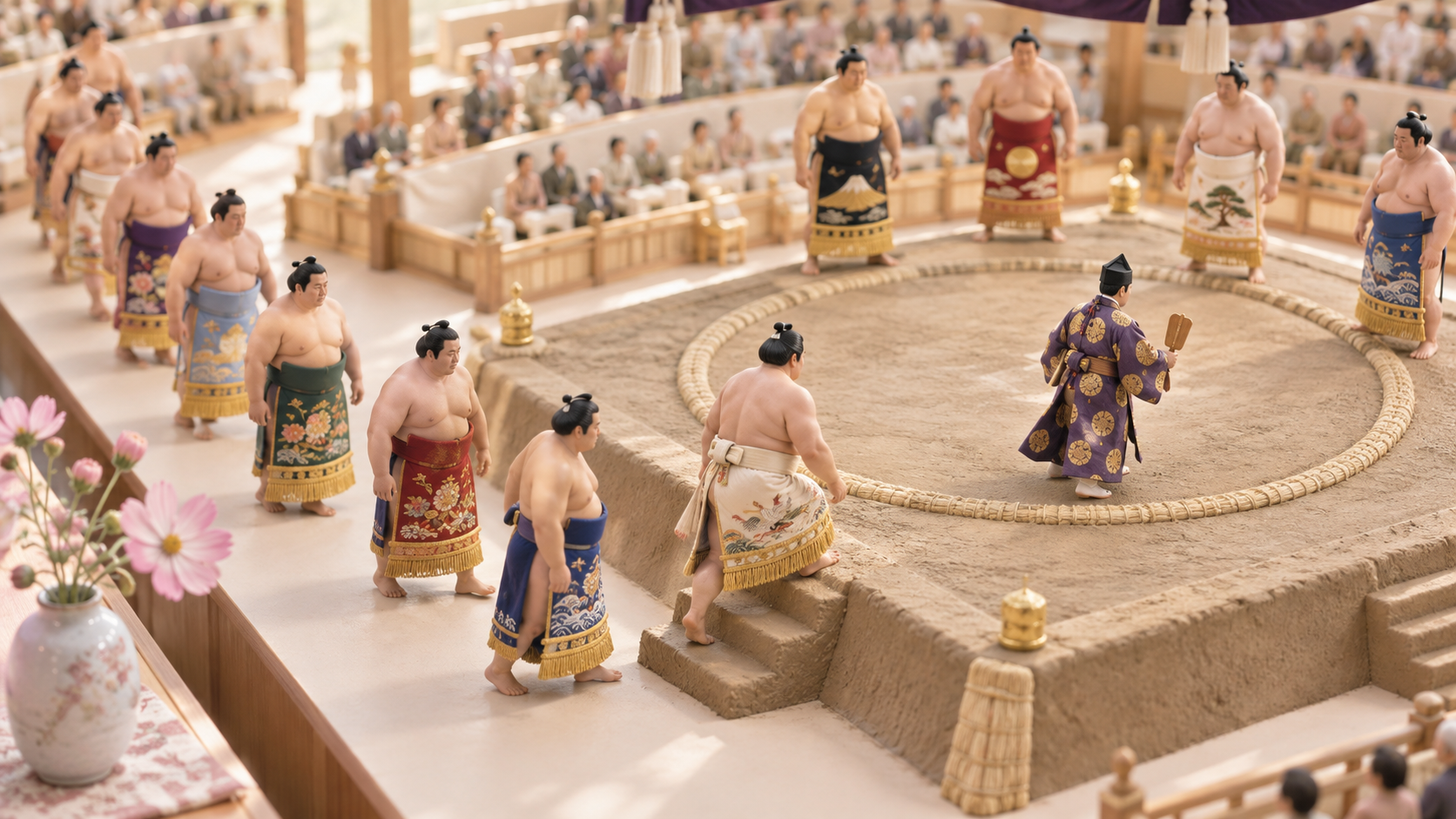
The makuuchi ring entrance is divided into east and west groups. On odd-numbered tournament days, the east group goes first; on even-numbered days, the west group does. Within each group, a gyoji leads and wrestlers join the ring one at a time from the lower ranks upward. Only after the last man completes the circle do they face inward for the shared gestures. For your next viewing, do not learn forty names—just predict which side will send out the first wrestler.
A whole division in embroidered kesho-mawashi can be visually overwhelming. If all you remember is “very colorful,” you have not failed. One small piece of order turns the parade into something easier to follow: the circle is assembled from the bottom of the ranking ladder upward.
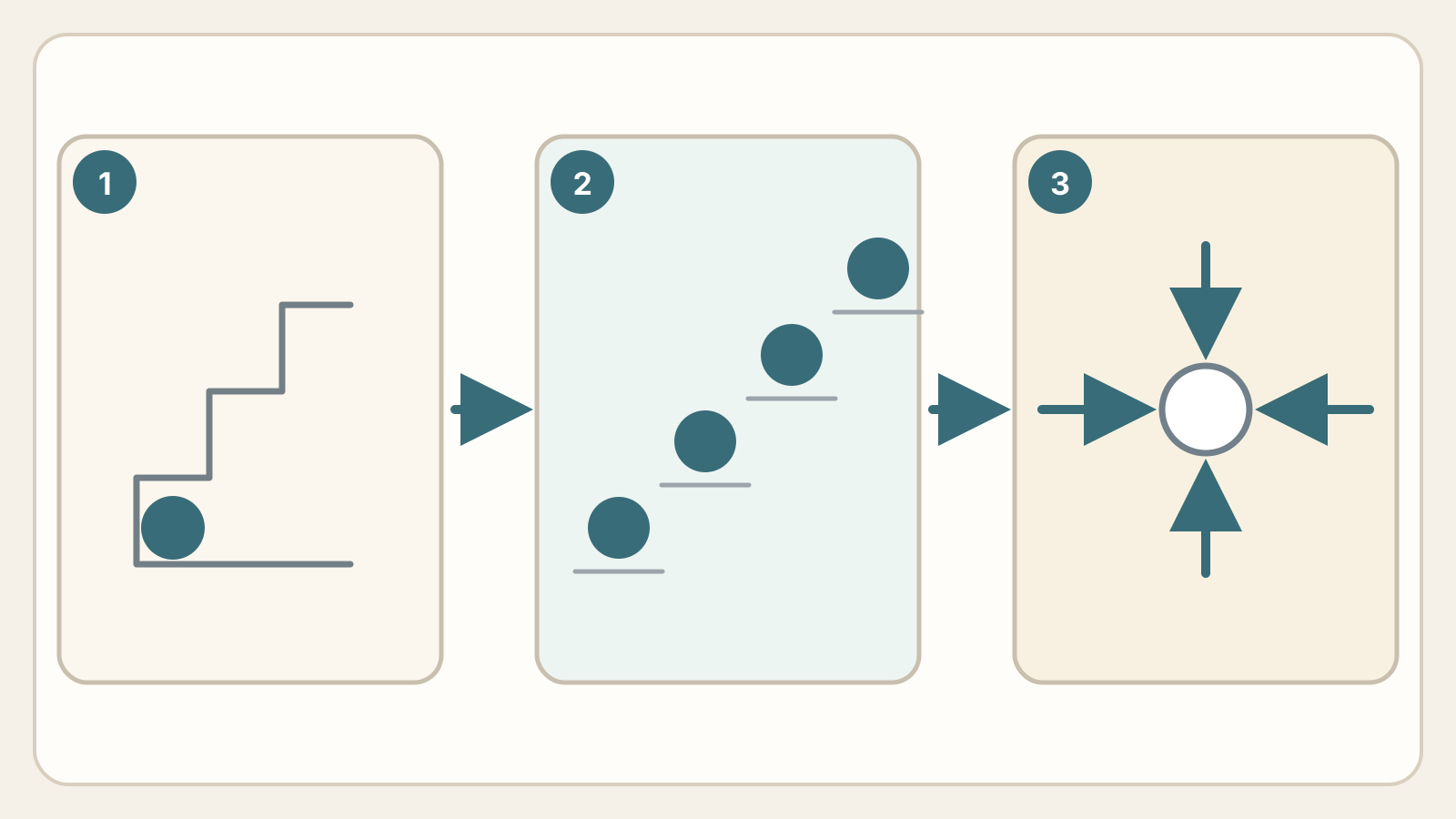
Detailed description of this diagram
Read three cards from left to right. The first has one anonymous token at the low end. The second places three tokens on rising steps solely to express joining from lower rank upward. The third points four short arrows toward an empty centre token, marking the state change after the last wrestler joins and the group faces inward. Tokens are not bodies or identifiable wrestlers, and four is not the real headcount. The first East/West side, hanamichi, venue bearing, dohyo outline, absences, exact rank spacing, timing, pose and current lineup are omitted.
Graphic: SUMO ARCHAEOLOGY CLUB · Figure source 1 · Figure source 2
Odd day: east first. Even day: west first
The Japan Sumo Association’s current Tokyo timetable states the side rule directly. Day 1, Day 3 and the other odd days begin with the east makuuchi group; Day 2, Day 4 and the other even days begin with the west group.
The official timetable establishes which side begins the ring entrance, but the selected sources do not establish that the yobidashi’s calling order follows the same odd-east, even-west rule. Do not infer the starting side from sound alone; compare the viewing-day timetable with the first wrestler to appear. The venue’s designated “east” and “west” need not match compass directions, so treat seating labels and the ring’s tassels as clues rather than a phone compass.
The circle grows from lower rank upward
The Association says a yobidashi’s wooden clappers cue the procession, a gyoji leads it, and wrestlers step onto the dohyo from the lower ranks upward. An official history note adds that, beginning with the January 1965 tournament, the format was revised so each wrestler could be introduced by microphone, joining one at a time and following the gyoji around the ring.
Absences can change the number you see, so do not insist that a particular named wrestler must occupy a particular visual position. Check the current banzuke and official absence information when the exact lineup matters. The reliable pattern to watch is the gradual rise through rank as the circle fills.
The group waits until everyone is on the ring
When the last wrestler arrives, the group turns inward. The official sequence is a clap, the right hand raised, the kesho-mawashi lifted slightly with both hands, and both hands raised high. The Association relates these abbreviated actions to chiri-chozu purification, the three postures and shiko respectively.
Our dedicated kesho-mawashi guide explains the garment and gestures in detail. Here the delightful point is timing: the first wrestler does not perform alone. He waits while the ring fills, then changes direction with everyone else. A list of names becomes one breathing circle.
The yokozuna entrance follows as a separate item
On a day when the yokozuna dohyo-iri is held, the official timetable places it after the makuuchi ring entrance as its own event. That ceremony has a very different small formation, with attendants serving as sword bearer and dew sweeper. Keeping the two entrances separate prevents a common first-visit confusion: the large divisional circle comes first, followed by the yokozuna ceremony when applicable.
Do not reuse a Tokyo clock time for Osaka, Nagoya or Fukuoka. The cited schedule page mixes a September heading with a May-tournament caveat, and times move with venue, day and bout progress; recheck the official guidance for the viewing day. The sequence—makuuchi group entrance, then the separate yokozuna entrance when applicable—is more useful than a fixed minute.
Its beginning is not securely dated
The Association traces makuuchi ring-entry history into the Edo period but explicitly says the exact starting date is not established. It points to surviving prints from the Kyoho era, 1716–1736, as confirmed evidence. That is a good reminder that “old” does not automatically mean “precisely dated.”
The form has also changed. The Association describes adjustments made as the number of makuuchi wrestlers grew, and the 1965 shift to spaced, individually announced entrances. Tradition here is not a frozen pose; it has been maintained partly by making the wrestlers easier for spectators to meet.
One thing to watch next
Check whether the tournament day is odd or even. Find the first wrestler from the correct side and remember one color in his kesho-mawashi. Keep that single person in view while the circle expands. When everyone turns inward, try to find him again.
Suddenly, a mass entrance contains someone you were waiting for. The next step is irresistible: you want his shikona, then his bout, then tomorrow’s result. The ring entrance is not only a roll call for fans who already know the division. It is a beautifully ordered way to discover the first wrestler you might begin to care about.
Sources
- Japan Sumo Association, September 2026 Tokyo dohyo timetable and Grand Sumo Quiz Nos. 1252, 1385, 1264 and 7 (accessed September 2, 2026)
Source links used for verification
Each link was used for the corresponding claim in this article; inclusion is not a blanket endorsement of the whole page.
Article verified:
- Japan Sumo Association September 2026 Tokyo dohyo timetablePrimary source (conflicting details noted)
- Japan Sumo Association Grand Sumo Quiz No.1252: ring-entry order and gesturesPrimary source (as checked for this article)
- Japan Sumo Association Grand Sumo Quiz No.1385: changes to the makuuchi entrancePrimary source (as checked for this article)
- Japan Sumo Association Grand Sumo Quiz No.1264: nakairiPrimary source (as checked for this article)
- Japan Sumo Association Grand Sumo Quiz No.7: ring colors and venue directionsHistorical primary source (record from that period)