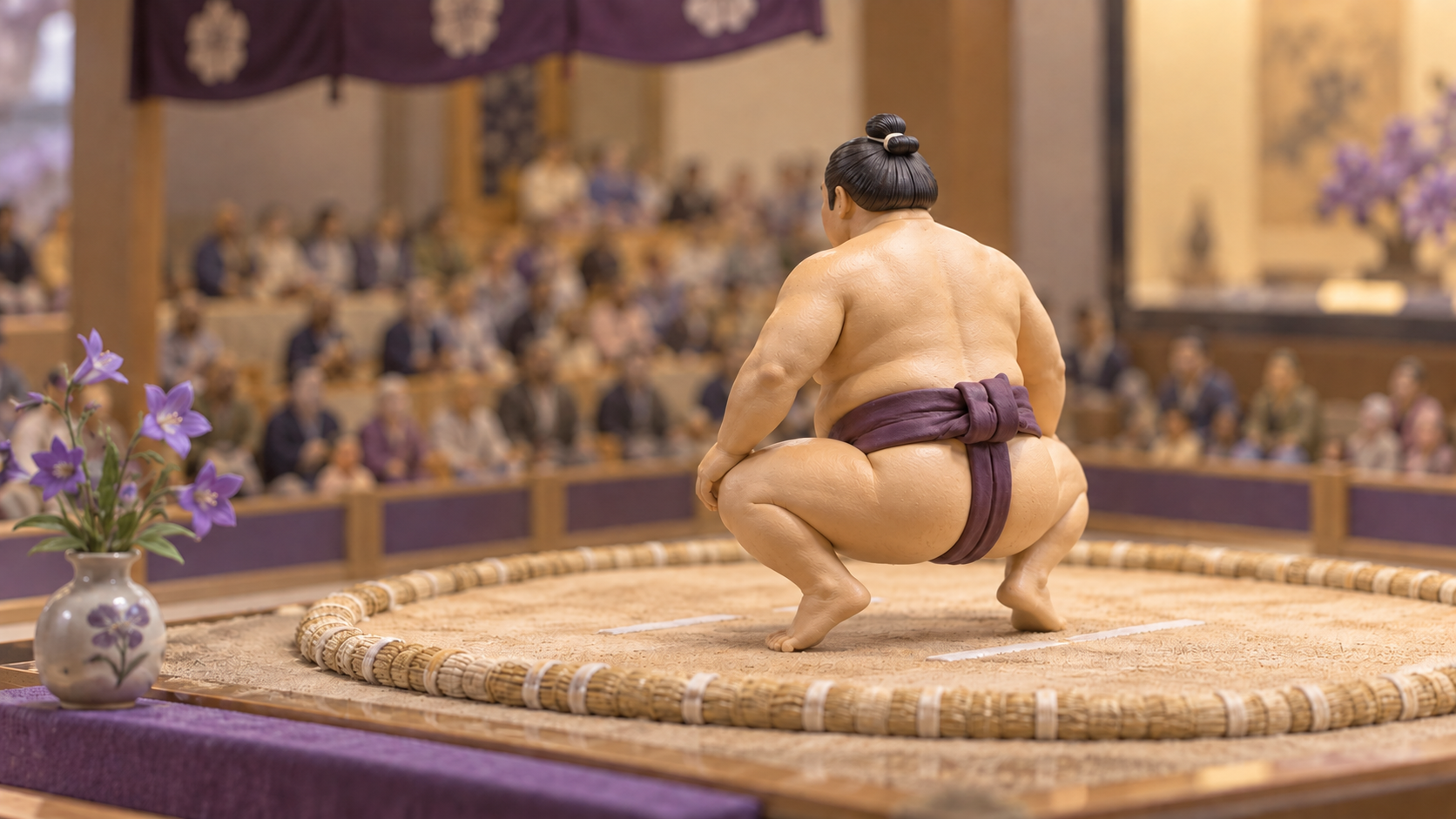
Sonkyo is a basic sumo posture made by keeping the upper body upright, bending the knees, lowering the hips deeply, opening the knees and balancing on the toes. Before a bout, a wrestler assumes it once while facing his opponent for chiri-chozu and again before entering the shikiri process. On your next bout, do not compare who crouches lower. Simply look for the same poised, low shape to appear twice.
When the tachiai is the only anticipated moment, every pre-bout descent can blur into “crouching.” Once you know sonkyo, the preparation gains punctuation. Near the edge, the posture supports an open-handed ritual. Later, it returns before the wrestlers move toward the starting lines. The great burst at the tachiai has two small moments of balance before it.
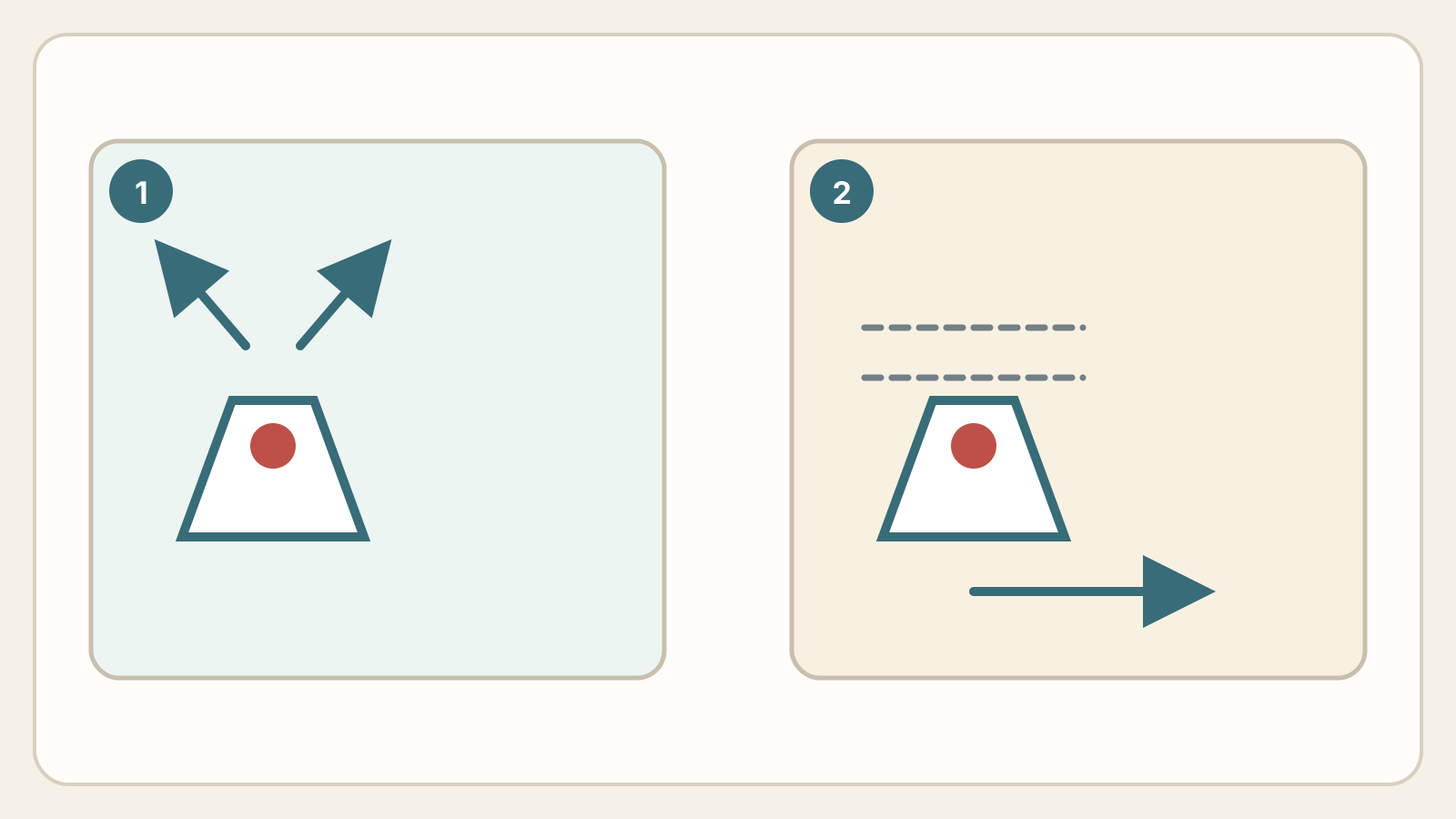
Detailed description of this diagram
Two cards use the same low trapezoid and central-dot state token. The left adds two small opening cues for the first occurrence during chiri-chozu. The right adds two parallel forward lines and a progress arrow for the second occurrence before entering shikiri. Repetition means the same basic posture reappears; the token is not a body or correct-pose silhouette. Knee, ankle, toe, torso and hip angles, depth, balance method, duration, niji-guchi or shikiri-line geometry, judging criteria, safe exercise instruction and a claim that every visible crouch is sonkyo are omitted.
Graphic: SUMO ARCHAEOLOGY CLUB · Figure source 1 · Figure source 2
What does sonkyo look like?
The Japan Sumo Association defines the posture from standing: the wrestler keeps his torso erect, bends his knees, lowers his hips deeply, opens both knees and balances on his toes. It is more specific than simply squatting as low as possible.
You do not need to judge whether a professional’s form is technically good. Pick one visible feature. Instead of folding forward at the waist, the upper body remains lifted as the whole frame becomes lower. A very large body appears to settle into a surprisingly compact base without losing its vertical line.
The first sonkyo supports chiri-chozu
After mounting the dohyo, the two wrestlers face each other near the inner edge. They take sonkyo and perform chiri-chozu: rubbing the hands, clapping once, opening both arms and turning the palms.
The hand sequence lasts only a moment. Starting your attention at the hips makes it easier to catch. Sonkyo creates a still platform from which the arms can perform the declaration. Our separate chiri-chozu guide follows every hand movement; here the interesting detail is how the quiet posture frames it.
The second comes before shikiri
The Association also says a wrestler assumes sonkyo before entering shikiri. He will then approach the white lines, lower himself, bring down his fists and work toward a mutually timed start with his opponent.
Sonkyo and shikiri are therefore connected but not interchangeable terms. Sonkyo names the basic balanced posture and its place in the etiquette. Shikiri is the process of preparing for the tachiai at the starting lines. Location and the next action tell you which moment you are seeing.
Why is it called a form of respect?
The official explainer also calls the posture *sonkyo-no-rei*, the “respect of sonkyo,” and identifies it as important dohyo etiquette. That should not be expanded into an unsupported story about submission to the opponent. The Association presents it as a basic posture through which the formal sequence is ordered.
This fits another official explanation: the clap performed on the dohyo is respect for the sacred ring, not applause for the other wrestler. Although the men face one another, not every pre-bout action is directed solely at the opponent. They are also entering a particular place through inherited forms.
Watching is not an exercise prescription
Sonkyo appears in the Association’s basic-movements material, but neither this article nor those pages can assess a reader’s knee or ankle load or safe depth. Do not copy a professional from a broadcast. If you attend an organised experience, follow the instructor, and seek appropriate clinical guidance for pain, a condition or personal mobility concerns.
As a spectator, appreciate the visible balance without testing your own depth against it. Compare the first appearance with the second, not yourself with the wrestler.
Find two islands of stillness
At the first sonkyo, watch for the arms to open and the palms to turn. After the second, watch the wrestler move toward the shikiri lines. If you find those two transitions in one bout, you already understand more than a glossary definition can provide.
Seen only from the tachiai, sumo seems to begin without warning. Seen from sonkyo, the force is prepared through balance, released, gathered again and finally brought to the lines. The waiting time becomes a small story in which respect gradually changes its centre of gravity into combat.
Keep More Than One Interpretation Open
We separate what the official or collection source establishes from our observation. A ritual, object or posture may have another interpretation or theory across periods, regions and explainers. When primary evidence does not establish a single origin or meaning, we leave it unknown or contested rather than turn visual resemblance into historical fact.
Evidence limits and event-day fallback
Confirmed fact: Current Association explainers describe sonkyo as an erect torso, bent knees, deeply lowered hips, open knees and balance on the toes, and place it at chiri-chozu and before shikiri.
What remains unknown: Individual joint angles, load, safe depth, technical quality, pain, injury, intent and off-camera action are not established. A visible posture is not a medical or exercise assessment.
Reasoned inference: Looking for the low posture twice may make the sequence from chiri-chozu to shikiri easier to parse. Confidence is medium; this is neither the only meaning of respect nor a test of good form.
Editorial suggestion: As a viewer, compare only the visible torso and next action. To try it, do not copy a broadcast: follow a qualified instructor and obtain appropriate clinical guidance for personal concerns.
Fallback: If the posture is hidden, follow the opened hands at the first point and movement toward the shikiri lines at the second. If it causes concern or pain, do not attempt it; keep this an observation.
Sources
- Japan Sumo Association, Grand Sumo Quiz Nos. 361, 815 and 1067; Sumo Basic Movements (accessed September 2, 2026)
Source links used for verification
Each link was used for the corresponding claim in this article; inclusion is not a blanket endorsement of the whole page.
Article verified:
- Japan Sumo Association Grand Sumo Quiz No.361: sonkyo form and occasionsPrimary source (as checked for this article)
- Japan Sumo Association Grand Sumo Quiz No.815: sonkyo during chiri-chozuPrimary source (as checked for this article)
- Japan Sumo Association Grand Sumo Quiz No.1067: sonkyo and the clap at the ring edgePrimary source (as checked for this article)
- Japan Sumo Association Sumo Basic MovementsPrimary source (as checked for this article)