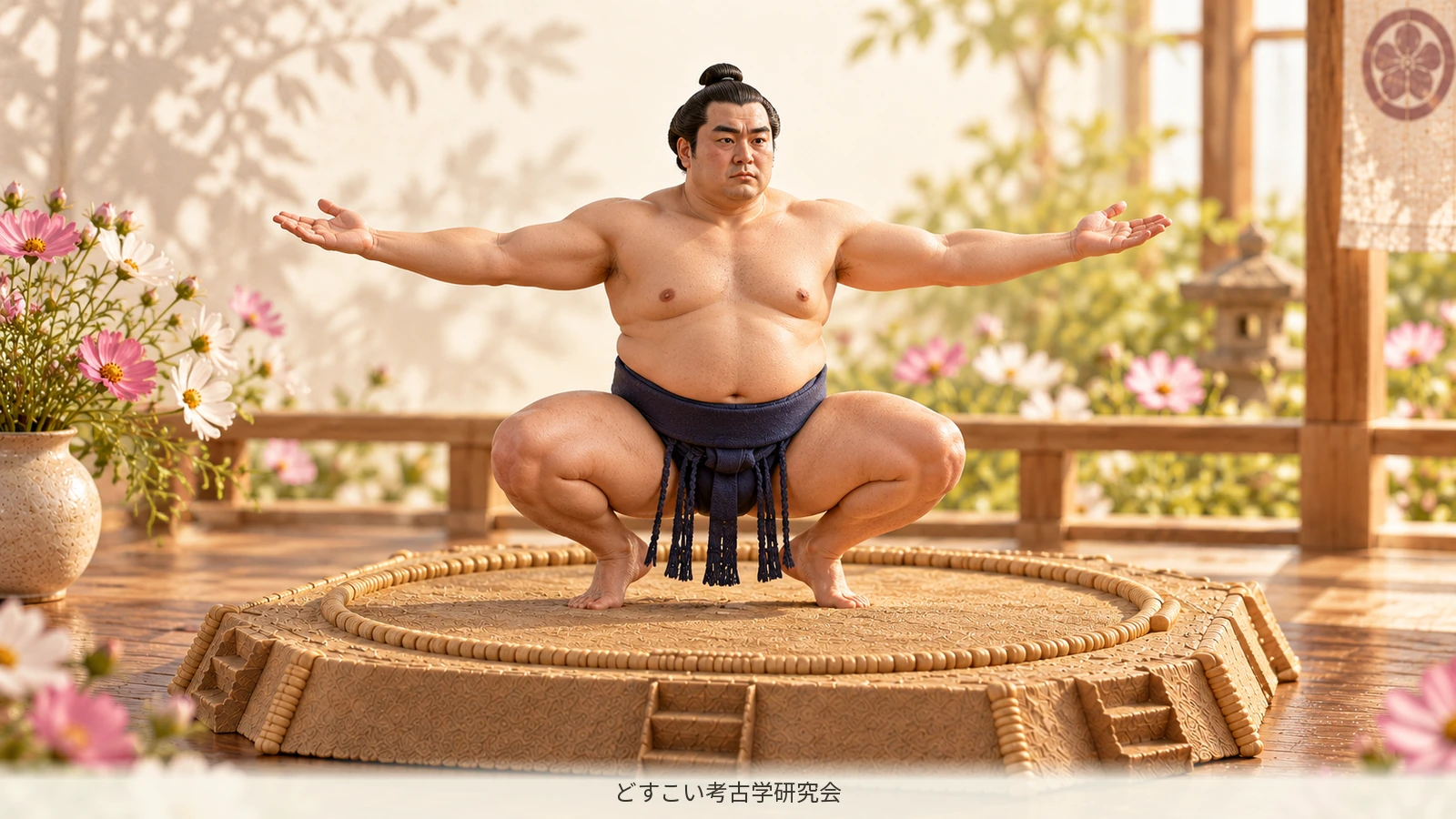
Chiri-chozu is the complete pre-bout gesture in which a wrestler assumes sonkyo at the inner edge of the dohyo, lowers both hands, rubs his palms, claps once, opens his arms with the palms up and then turns them down around shoulder height. The Japan Sumo Association explains the rubbing as purification and the open, turning hands as a declaration that he carries no weapon and will compete fairly with bare hands. On the next bout, do not stop watching at the clap. Wait for the palms to turn.
A high arc of salt is easy to remember. Chiri-chozu happens more quietly, so it can register as little more than “the part where they spread their arms.” The intriguing detail is the final turn: why show the palms and then deliberately rotate them? Following that one question reveals a compact ritual of cleansing and promise before the collision.
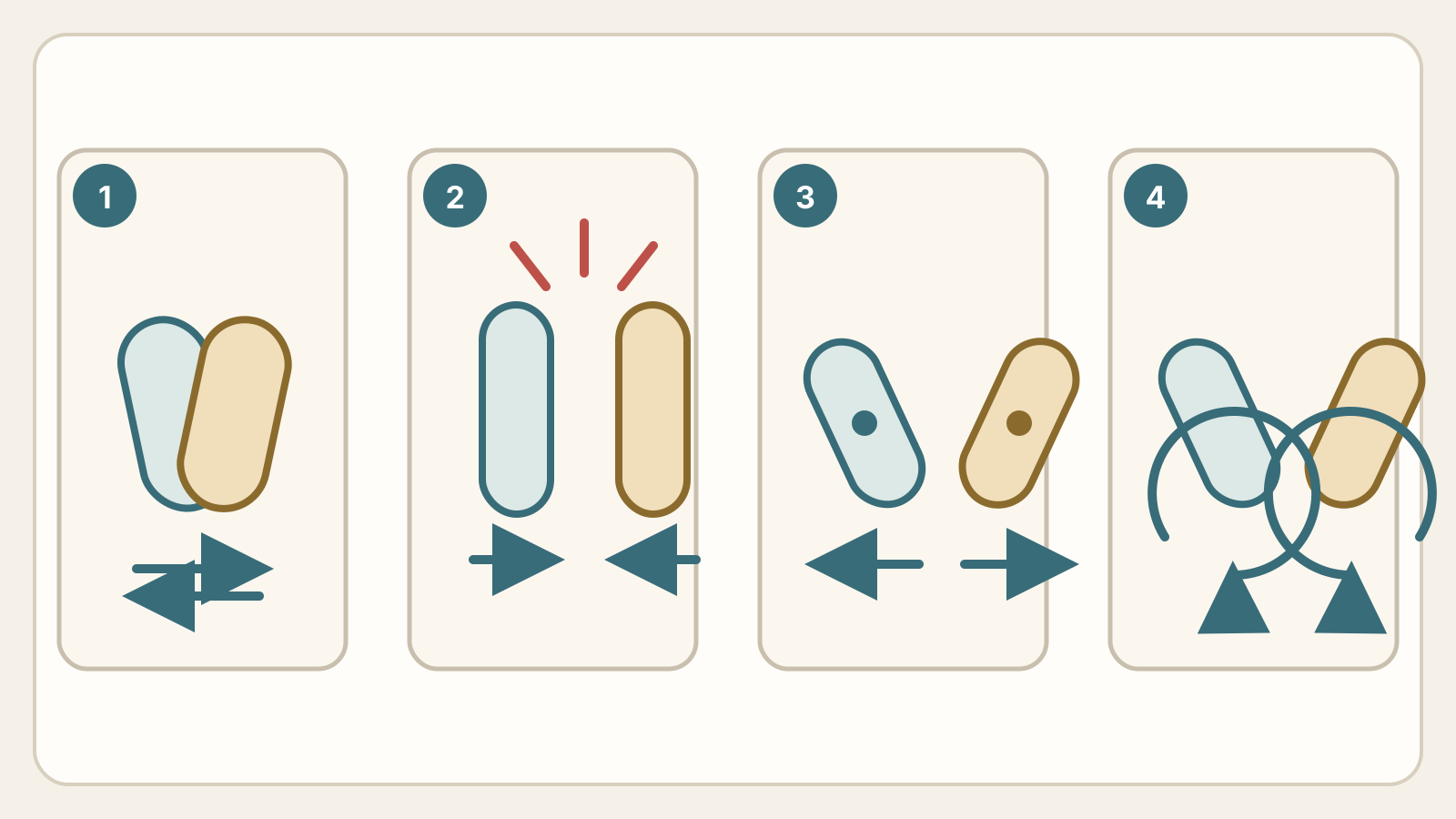
Detailed description of this diagram
Four cards run left to right. Card 1 uses two lozenges and reciprocal arrows for palm rubbing. Card 2 brings two lozenges together with inward arrows and a small burst for one clap. Card 3 separates two lozenges and adds small upward cues for opening with palms up. Card 4 places rotation arrows around the same tokens for turning the palms down. Lozenges are state symbols, not hands or bodies. Sonkyo, niji-guchi location, shoulder height, arm angle, speed, range of motion, finger form and any performance or judging standard are omitted.
Graphic: SUMO ARCHAEOLOGY CLUB · Figure source 1 · Figure source 2
The whole sequence, not just the clap
The Association gives the order as follows:
- Take the low sonkyo posture inside the *niji-guchi*, one of the two breaks in the ring of bales.
- Lower both hands once.
- Rub the palms together.
- Clap once.
- Open both arms with the palms facing upward.
- Turn the palms down at about shoulder height.
The name does not refer only to the clap. Chiri-chozu runs from the rubbing of the hands through the opening and turning of the palms. From a distant seat, individual fingers may disappear. Follow the elbows instead: they move outward, then the forearms rotate. That is enough to keep the final promise in view.
Purification and an empty-handed promise
The palm-rubbing represents cleansing the hands. The turned, exposed hands show that the wrestler holds no weapon and pledges a fair bare-handed contest, according to the official explanation. This is not a modern security check. It is a ritual action retained before the bout.
The Association also presents a traditional origin story: in an era of outdoor sumo, when water was unavailable, wrestlers are said to have cleansed their hands with grass. It is useful to keep the attribution attached. The page gives the Association’s transmitted explanation; it is not a licence to invent a precise date, location or uninterrupted historical chain that the source does not establish.
Whom is the clap for?
Another Association explainer says that the clap on the dohyo is an expression of respect for the sacred ring, not applause for the opponent or the crowd. A wrestler claps during the first ritual near the edge and again after receiving chikara-mizu, the “power water” used before the bout.
The two sounds can seem identical to a newcomer, but they occupy different moments. At the first one, stay with the hands as they open. At the later one, our chikara-mizu guide follows the water, paper and ringside helper. Separating the sounds by what comes next is easier than memorising a long ceremonial checklist.
Chiri-chozu is not the shikiri
Chiri-chozu is performed in sonkyo near the edge of the dohyo. The wrestlers then continue their preparations and eventually move to the shikiri lines, where they crouch, place their fists and coordinate the start.
Because several low postures occur in succession, international viewers sometimes call the entire pre-bout period “the starting crouch.” Watch the hands and location instead. Arms opening near the edge signal chiri-chozu. Fists descending by the white starting lines belong to the shikiri process.
A compressed version appears in the group ring entrance
When the juryo or makuuchi wrestlers form a circle during their division ring entrance, they clap once and raise the right hand. The Association describes this as an abbreviated form of chiri-chozu. The full individual gesture and the compact group version can therefore appear on the same tournament day.
Try pairing them. During the ring entrance, notice one raised right hand. Before a bout, wait for both palms to open and turn. A bright procession of kesho-mawashi and a private-looking pre-bout promise stop being separate pieces of theatre; they become two scales of the same movement.
One thing to watch next
You do not need to memorise all six steps. After the clap, look for the palms to face upward and then disappear as they turn down. The rotation matters because an empty hand is not merely flashed; both sides are made visible through movement.
The bout itself may last only seconds. Before it begins, however, both men have used the same form to cleanse their hands and show that nothing is concealed. Once chiri-chozu becomes visible, the tachiai no longer feels like an unexplained impact. It is the instant after two quiet promises have been completed.
Sources
- Japan Sumo Association, Grand Sumo Quiz Nos. 815, 1067 and 912; Sumo Basic Movements (accessed September 2, 2026)
Source links used for verification
Each link was used for the corresponding claim in this article; inclusion is not a blanket endorsement of the whole page.
Article verified:
- Japan Sumo Association Grand Sumo Quiz No.815: chiri-chozu sequence and meaningPrimary source (as checked for this article)
- Japan Sumo Association Grand Sumo Quiz No.1067: the clap as respect for the dohyoPrimary source (as checked for this article)
- Japan Sumo Association Sumo Basic MovementsPrimary source (as checked for this article)
- Japan Sumo Association Grand Sumo Quiz No.912: abbreviated ring-entry gesturesPrimary source (as checked for this article)