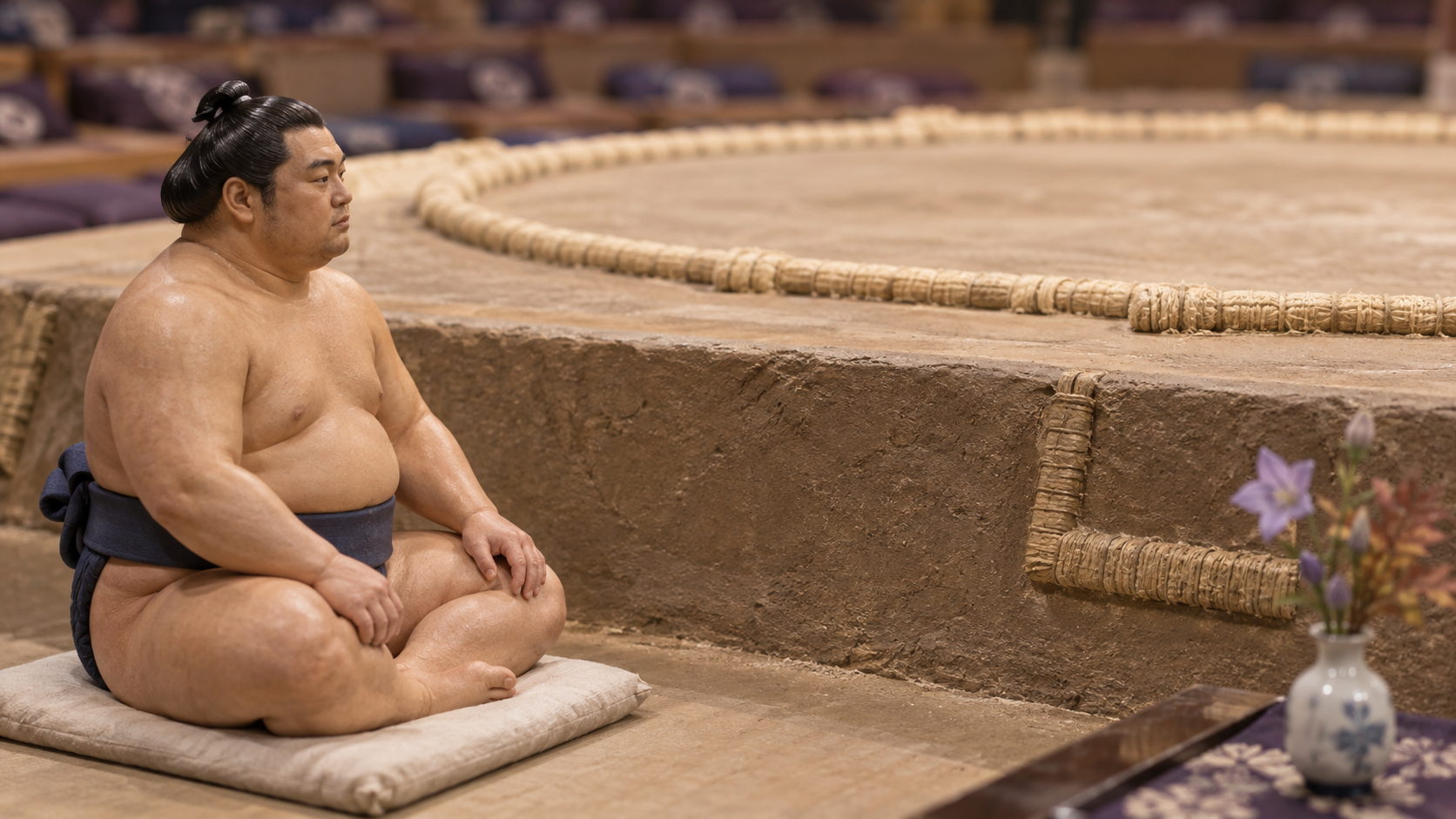
The wrestlers seated immediately below the east and west sides of the dohyo are *hikae-rikishi*: competitors waiting for their turns. The Japan Sumo Association states that a wrestler must be in the designated ringside waiting area from two bouts before his own. On your next viewing, ignore one side of the ring and watch the other just after a match ends. A new wrestler taking a seat reveals how the entire day’s programme moves forward.
A large man in a mawashi sits at the edge of the picture while two other men compete. Is he a teammate, an alternate, or somebody whose bout has already finished? The answer is usually on the schedule rather than in his expression. The next contestants are already waiting close to the dohyo, and their arrival follows a rule.
Hikae-rikishi wait in the east and west tamari
The Association defines a hikae-rikishi as a wrestler seated in the east or west *dohyo-damari* while waiting for his sumo turn. *Tamari* refers to the area directly below the raised ring where ringside judges, waiting wrestlers and a standby gyoji may be positioned. It is part of the working space around the contest, not simply a front-row spectator section.
An east-side wrestler uses the east hanamichi, and a west-side wrestler uses the west passage. If an official bout list or on-screen graphic identifies a competitor’s side, look below that side of the ring. Remember that “east” and “west” are sumo’s assigned sides and may not agree with geographic directions in the venue.
“Two bouts before” is the official timing
Association quiz No.1278 quotes the requirement: a waiting wrestler must reach the designated tamari from two bouts before the bout in which he competes.
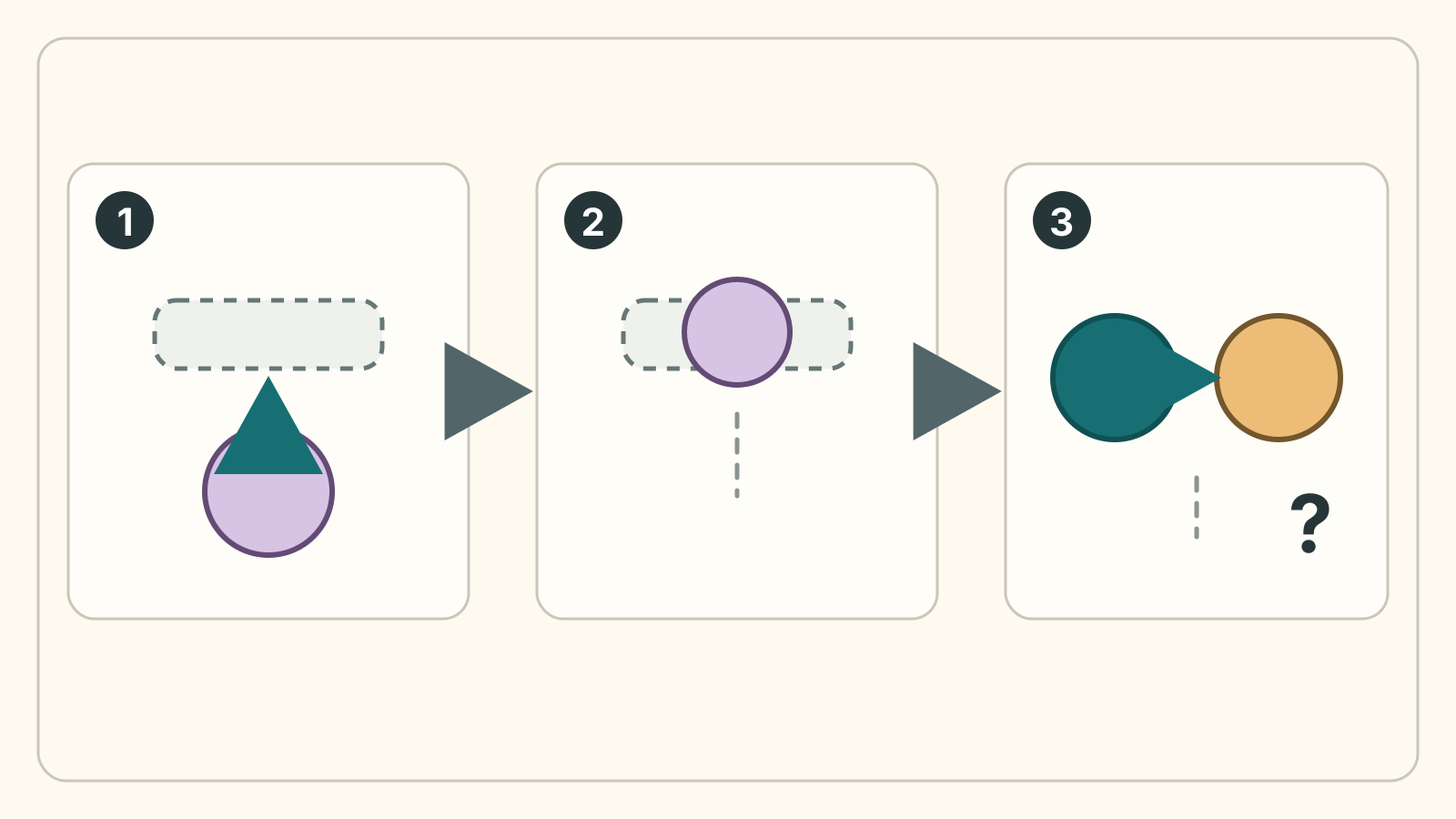
Imagine three consecutive matches labelled A, B and C. The wrestlers scheduled for C must be in place while A is taking place. When A ends and the pair for B climb onto the dohyo, C has become the next contest. This two-bout window explains why the people at ringside shift gradually rather than appearing only when the yobidashi begins the next call.
You may not be able to verify every arrival. A broadcast camera can crop out one tamari, and an arena sightline can be blocked. An unseen wrestler should not be reported as absent. Treat this as an observational clue when the area is visible, not as a remote attendance system.
Detailed description of this diagram
Cards 1, 2 and 3 are consecutive bout-order slots only. A purple waiting-wrestler role enters the waiting band at card 1, remains through card 2 and reaches the wrestler's own bout in card 3. A dashed path and question mark below card 3 separate the conditional convention in which certain late-card winners remain for power-water duty. Page position encodes no east/west tamari seat, route, distance, duration, posture, opponent, water action or psychology.
Graphic: SUMO ARCHAEOLOGY CLUB · Figure source 1 · Figure source 2 · Figure source 3
Some wrestlers remain after winning
Not every wrestler at ringside is necessarily waiting for a future bout. Late in the day’s programme, a winner may stay instead of returning through the hanamichi. The Association calls this *kachinokori*, remaining after a win.
Its official example involves the winners from two bouts before the final match and immediately before the final. They remain so that the next wrestler from the same side can receive water. The cited Association pages do not establish every exception or a general substitute-attendant rule, so this article leaves other cases unresolved.
Time, rather than clothing or facial expression, helps distinguish the situations. Did the wrestler arrive before an upcoming appearance, or did you just watch him win and then remain seated? The first is the waiting sequence; the second may be kachinokori and the handover of water.
Do not invent a psychological reading
A waiting wrestler may look down, close his eyes, shift his body or watch the bout in front of him. Those visible actions do not prove that he is nervous, supremely confident, planning a particular tachiai or ignoring the action. Unless the wrestler or an authoritative source explains the moment, inner feelings remain unknown.
The verified fact is interesting enough: before stepping up for his own few seconds of competition, he has already spent two bouts in the immediate environment of the ring. The sound of the clay, the yobidashi’s voice and the audience reaction are not arriving for the first time when his name is called.
For an international visitor, this can also make a long tournament day easier to read. You do not need fluent Japanese commentary to see the next layer of the running order assembling beside the dohyo.
Follow the arena’s quiet conveyor belt
Choose east or west; do not attempt both. After a bout, look towards that hanamichi and its ringside waiting area. Does a wrestler rise for the next match? Does a different wrestler arrive and sit? If you can identify only the movement and not the names, the exercise still works.
Before the yobidashi calls the next pair, the pair after them is already nearby. Each conclusion therefore resets more than the clay. People move one place closer to their turn, and the visible edge of the dohyo becomes a living running order.
Watch one thing in the next bout
When the result is settled, keep your eyes on one tamari for a few seconds. Look for one new arrival. If someone who just won remains instead, watch whether he later offers water to a wrestler from the same side.
The seated figures stop looking like background once you know their place in time. A bout may last only seconds, but two future bouts are already waiting beside it. That is how a full day’s sumo advances: not with an empty stage between matches, but with the next story quietly taking a seat.
Evidence limits and event-day fallback
Confirmed fact: Current Association explainers state that a waiting wrestler reaches the designated tamari two bouts before his own, describe the tamari, and give examples of particular pre-final winners remaining to provide water.
What remains unknown: Off-camera arrival, actual route/seat, every exception or substitute, an individual’s waiting reason, emotion, plan, pain and injury are not established. The cited pages do not state a general substitute-attendant rule.
Reasoned inference: Separating bout order from whether a person arrived before a future bout or stayed after winning may help distinguish waiting and kachinokori. Confidence is medium; face or clothing alone does not identify person or role.
Editorial suggestion: Follow one side only beside the official bout list. Record visible arrivals/departures without filling in inner state or absence. This is not an arena access or movement instruction.
Fallback: If the tamari or arrival is hidden or an exception is possible, never report absence or lateness; return to the official bout list, arena explanation and result. The order remains observable without a name.
Sources
- Japan Sumo Association quizzes No.1278, No.930 and No.483 (verified 3 September 2026).
Source links used for verification
Each link was used for the corresponding claim in this article; inclusion is not a blanket endorsement of the whole page.
Article verified:
- Japan Sumo Association quiz No.1278: wrestlers arrive two bouts earlyPrimary source (as checked for this article)
- Japan Sumo Association quiz No.930: the ringside tamariPrimary source (as checked for this article)
- Japan Sumo Association quiz No.483: kachinokoriPrimary source (as checked for this article)