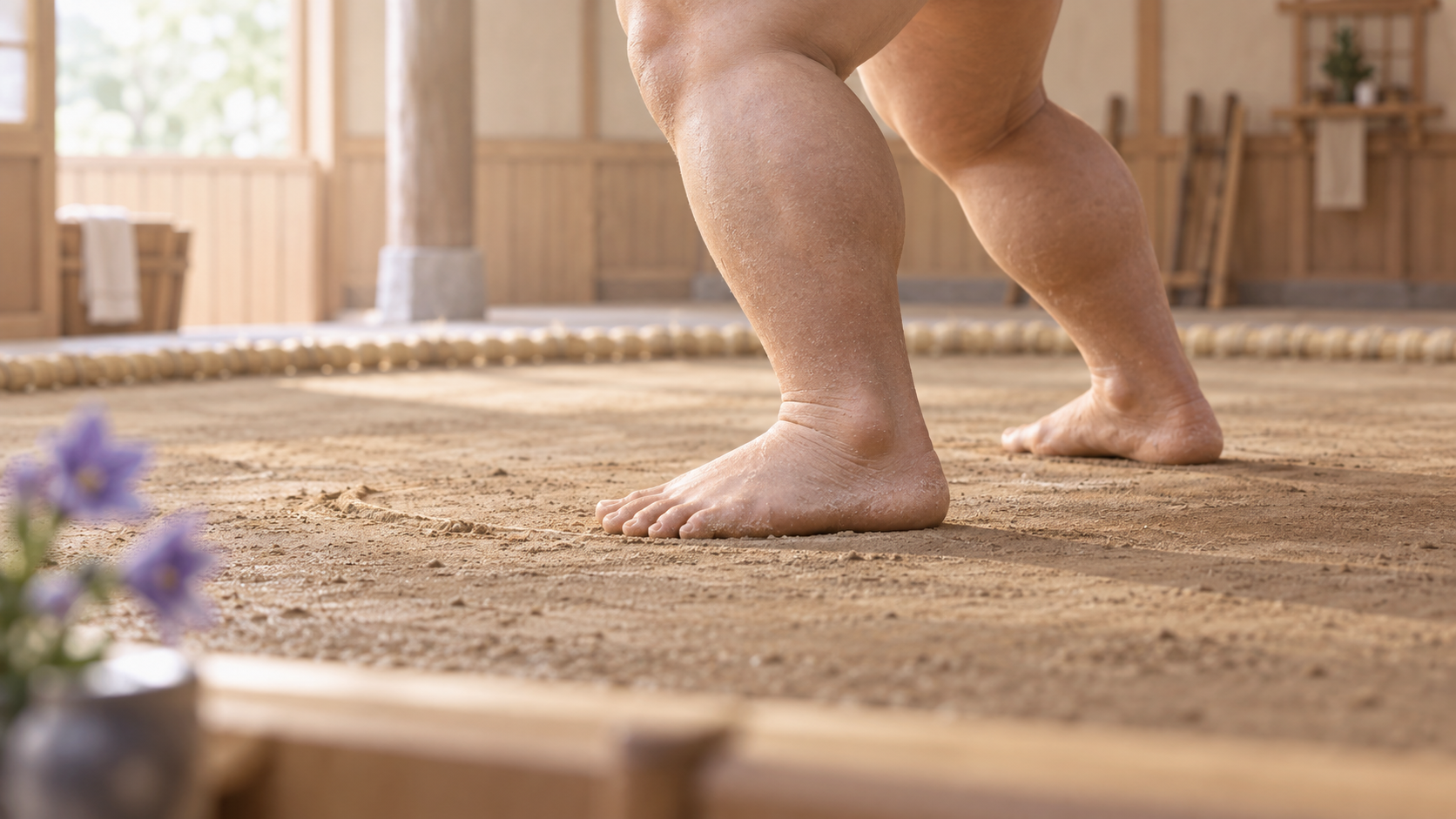
Suriashi is a basic movement performed with the hips lowered and the soles kept close to the ground as the feet slide. A Japan Sumo Association photo report shows both forward and sideways versions. When watching practice, ignore speed at first and follow the wrestler’s hip level and the length of time each sole remains connected to the surface.
Compared with shiko or butsukari, suriashi may seem visually modest. A bout may contain footwork that resembles the report, but the photographs do not prove that suriashi transmitted force or caused continued pressure in a particular contest. Treat the resemblance as an observation hypothesis.
How it differs from ordinary walking
The Association’s youth stable open-day report describes lowering the hips and moving while keeping the soles against the ground. It also depicts lateral suriashi.
The photo report describes movement with the soles on the ground and shows a lateral example. It does not quantify the difference from ordinary walking or a centre-of-mass path. This is not a self-training method; practical instruction belongs with a qualified instructor.
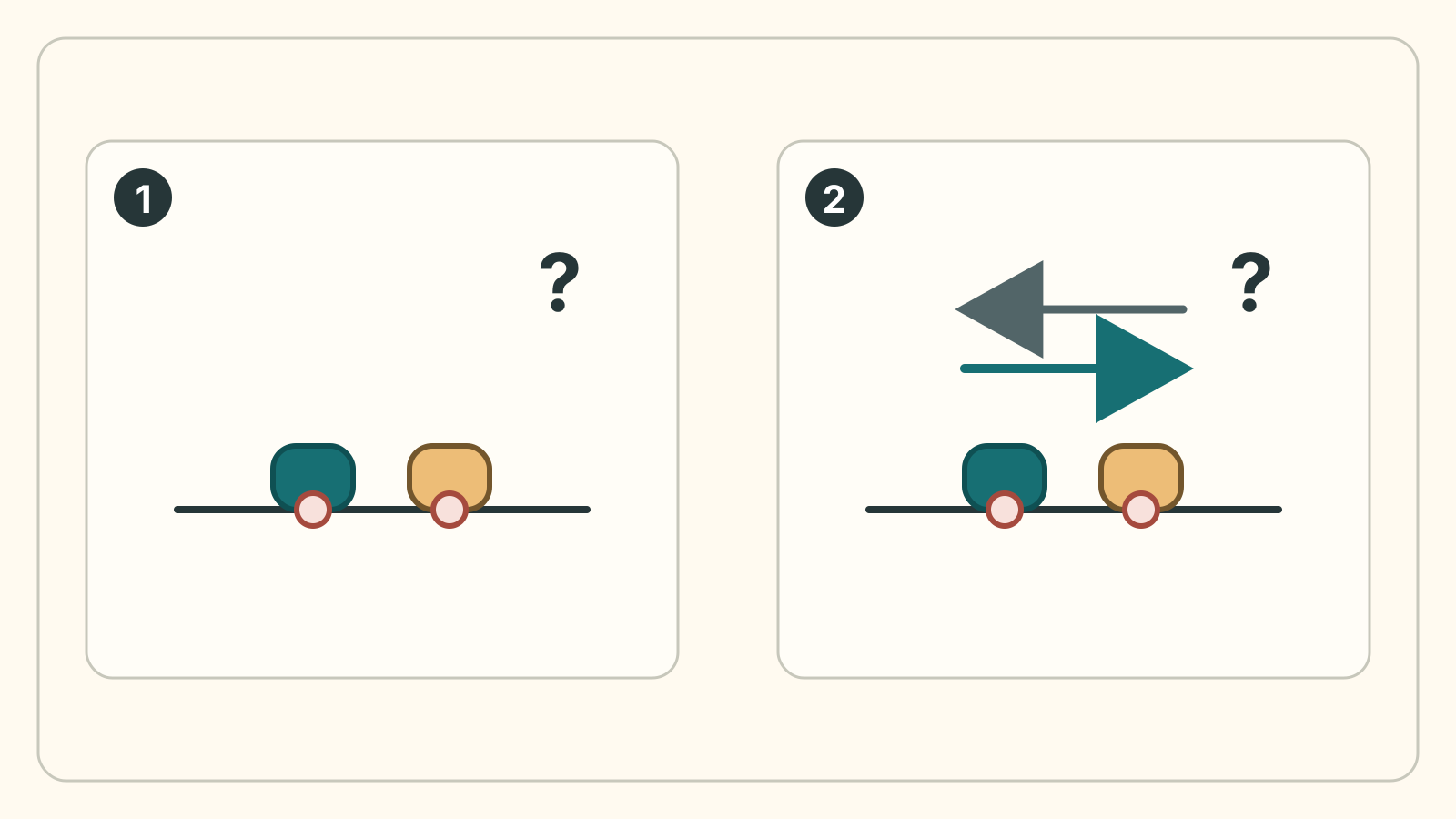
Detailed description of this diagram
Card 1 joins two abstract support blocks to a surface line with contact dots, preserving only the stated sole-to-ground relation. Card 2 keeps that relation and adds opposing categorical arrows to acknowledge movement options, including the report's lateral example. Blocks are not feet or legs, and arrow length and page direction encode no actual position, path, stride, speed, force, hip/shoulder height, centre of gravity, balance, efficacy or practice instruction.
Graphic: SUMO ARCHAEOLOGY CLUB · Figure source 1 · Figure source 2
Watch the shoulders as well as the hips
Hip, shoulder, stance and arm/leg movement may look different between repetitions. Record those visible differences separately; appearance alone does not establish force transmission, correct form, technical quality or physical condition.
The Association’s sumo health exercise page names shiko, teppo and suriashi as representative basic movements. It says their design brings the centre of gravity toward the lower abdomen and helps stabilise the body’s central axis. That is the Association’s explanation of the exercise system, not a medical guarantee about an individual wrestler.
Find the movement inside a tournament bout
The cited photo material does not establish that suriashi belongs only to one fighting style. If a bout contains similar quiet steps, keep them as a pre-finish observation rather than assigning a style, plan or cause of victory.
During practice, listen for less of a kick and more of a sole brushing the clay. Then watch the same wrestler in competition. The moment the hips stay low through two or three forward steps, an ordinary drill becomes a piece of foreshadowing. Suriashi is wonderfully addictive because the basic movement is almost invisible until you know where to look.
Observation note
- Hip height through successive steps
- Sole remaining close to the surface
- Forward and lateral movement
- Shoulder movement and stance width
- Small step before the named winning technique
Evidence limits and event-day fallback
Confirmed fact: An Association youth photo report describes suriashi with lowered hips and soles kept on the ground and shows a lateral example. The current sumo-health-exercise page also names shiko, teppo and suriashi as representative basics.
What remains unknown: Photos do not establish required professional angles, speed, force, centre of mass, cause, competitive effect, safe load/repetitions, fatigue, pain or injury. A health-exercise explanation is not a medical-outcome guarantee.
Reasoned inference: Following how long a sole appears close to the surface together with visible hip/shoulder level may reveal quiet footwork. Confidence is low to medium; it is not technical grading or a cause of victory.
Editorial suggestion: Observe one step and record any resemblance between practice and a bout as a hypothesis. Do not self-teach from photographs; use a qualified instructor and appropriate clinician for personal practice concerns.
Fallback: If the feet are hidden, do not classify; wait for another step. Stop an attempted exercise if there is concern or pain and seek suitable instructional or clinical guidance.
Sources
- Japan Sumo Association, youth stable open-day photo report and sumo health exercise page, checked September 3, 2026.
Source links used for verification
Each link was used for the corresponding claim in this article; inclusion is not a blanket endorsement of the whole page.
Article verified:
- Japan Sumo Association youth stable open-day photo reportHistorical primary source (record from that period)
- Japan Sumo Association sumo health exercisePrimary source (as checked for this article)