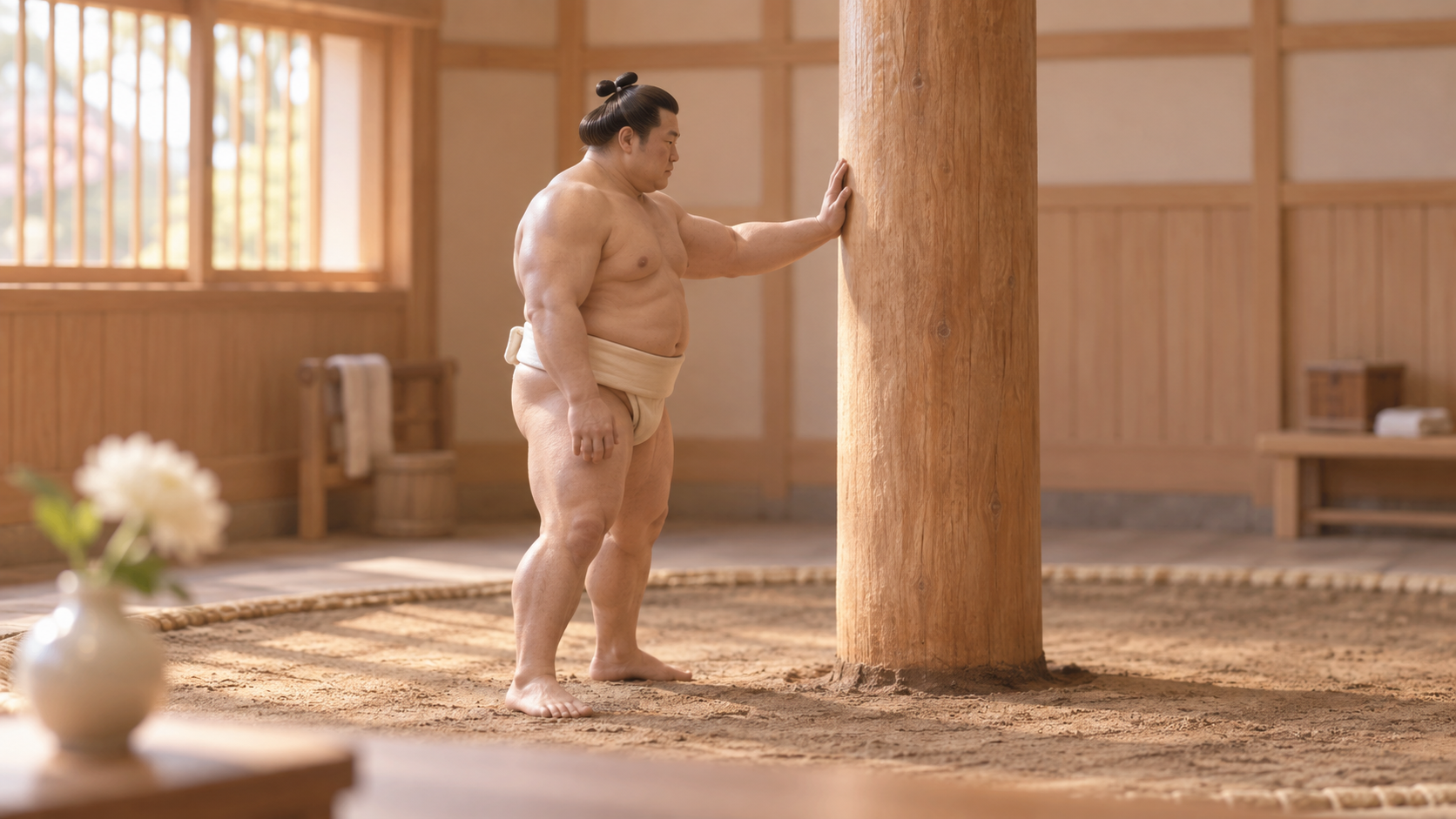
A Japan Sumo Association photo report shows wrestlers and instructors practising at a teppo post, and its health-exercise page names teppo among representative basics. Do not infer force from sound. Record separately when the hand, hip and foot appear to move; this is not a rule that same-side parts must link.
The martial name and contact sound invite a story about arm strength and a whole-body force path. The cited photographs do not establish force, required linkage or the difficulty of the task. They do show repetitions that can be compared side by side.
Do not isolate the palm
For each right- and left-side contact, record when the hip and foot appear to move. A photograph or sound does not establish the centre-of-mass path, force sequence or a correct whole-body prescription; it supports only visible timing observations.
The Association’s sumo health exercise page names shiko, teppo and suriashi as representative fundamentals. It describes these movements as bringing the centre of gravity toward the lower abdomen and stabilising the body’s central axis. The public health-exercise version is not evidence of a professional session’s intensity, purpose or whole-body force transmission. It confirms only that the Association includes teppo among the representative movements in that exercise system.
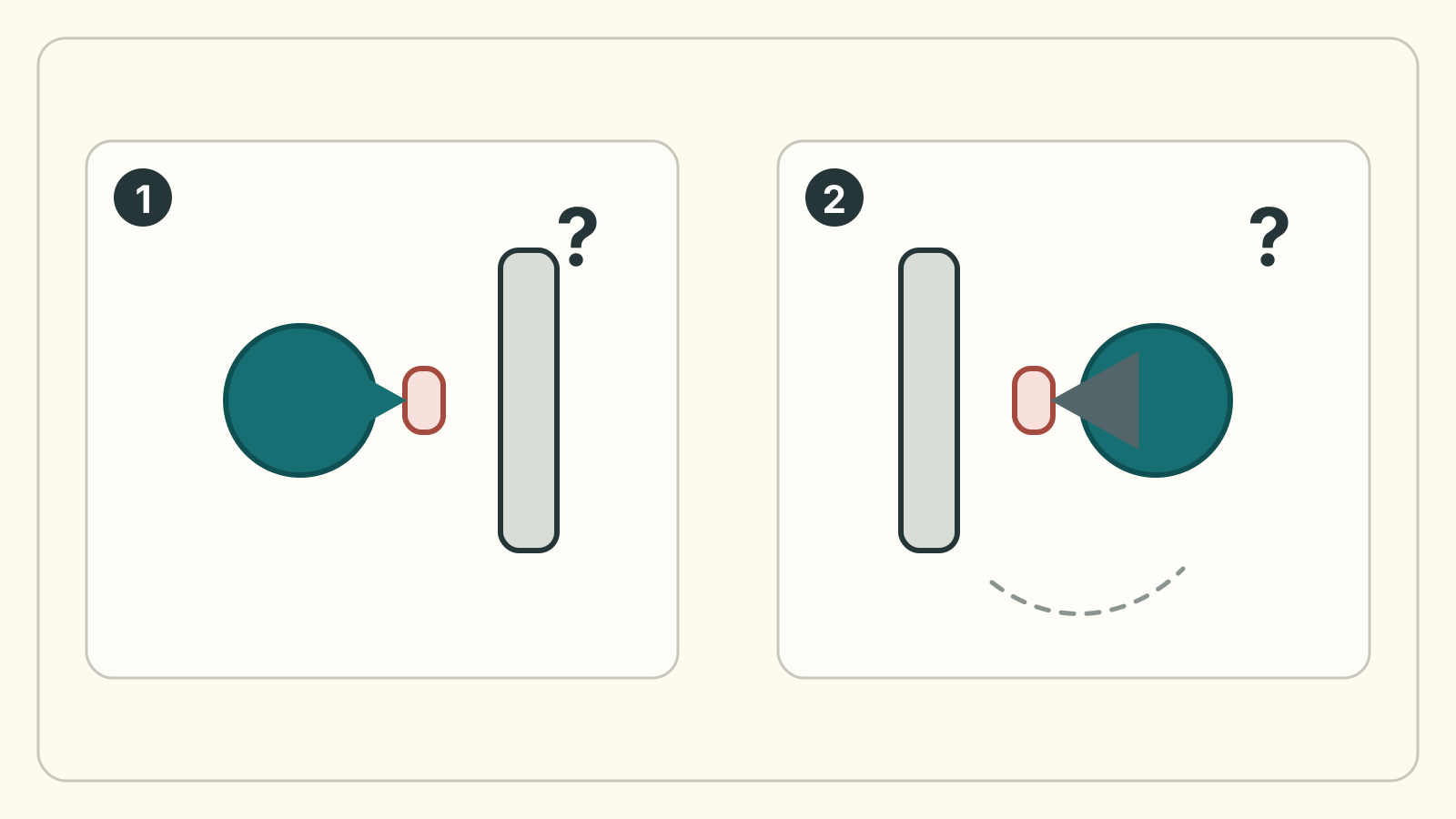
Detailed description of this diagram
Cards 1 and 2 place the same blue state token and a contact block on opposite sides of one abstract target bar. This is only an observation classification for comparing successive sides; the blue token means neither a left/right hand, hip, foot nor a person's measured position. The bar does not copy a real pillar's form, height or material. Question marks withhold contact point, same-side linkage, posture, weight transfer, rotation, return, sound, force, repetitions, load, safety or diagnosis not published by the cited sources.
Graphic: SUMO ARCHAEOLOGY CLUB · Figure source 1 · Figure source 2
Look for an asymmetry without diagnosing it
The two sides of one wrestler may not appear perfectly mirrored. Contact height, hip rotation, step length and return speed can differ. Record the visible difference, but do not diagnose an injury or declare a weak side from one session. Training load and the task assigned that morning remain unknown.
In a tournament bout there is no stationary post, and the opponent responds. Teppo does not reappear as a named kimarite in a simple copy. Instead, look inside a pushing exchange for the same continuity: hands advancing while the feet continue to carry the body.
Observation is not permission to imitate
Association photographs do not provide load, repetitions, post specification, medical guidance or a personal safety assessment. Do not reproduce the action on a wall or unverified post; practical training belongs with suitable equipment and a qualified instructor.
Try watching a short teppo sequence once without sound. Compare the visible contact, hip and foot timing across sides. Removing the sound can change what you notice, but it does not reveal a force path or prove correct linkage.
Observation note
- Same-side hand, hip and foot
- Weight transfer as sides alternate
- Shoulder not travelling alone
- Continuous feet inside tournament pushing
- No unsupervised imitation
Evidence limits and event-day fallback
Confirmed fact: An Association youth photo report shows instructors and participants practising at a teppo post; the current sumo-health-exercise page names teppo among representative basic movements.
What remains unknown: Photos do not establish contact height, required hand/hip/foot linkage, centre of mass, force, speed, load, repetitions, post specification, professional purpose, safety, fatigue, pain or injury.
Reasoned inference: Watching visible movement on alternating sides without sound may redirect attention beyond the hand. Confidence is low; it is not a force pathway, technical grade or physical diagnosis.
Editorial suggestion: Record separately when contact, foot and hip appear to move. Do not turn correlation into ‘correct linkage’, and do not reproduce it on a wall or post without proper instruction.
Fallback: If movement is hidden, do not infer force from sound; wait for another repetition. To practise, use suitable equipment and a qualified instructor, and seek appropriate clinical advice for personal physical concerns.
Sources
- Japan Sumo Association, youth stable open-day photo report and sumo health exercise page, checked September 3, 2026.
Source links used for verification
Each link was used for the corresponding claim in this article; inclusion is not a blanket endorsement of the whole page.
Article verified:
- Japan Sumo Association youth stable open-day photo reportHistorical primary source (record from that period)
- Japan Sumo Association sumo health exercisePrimary source (as checked for this article)