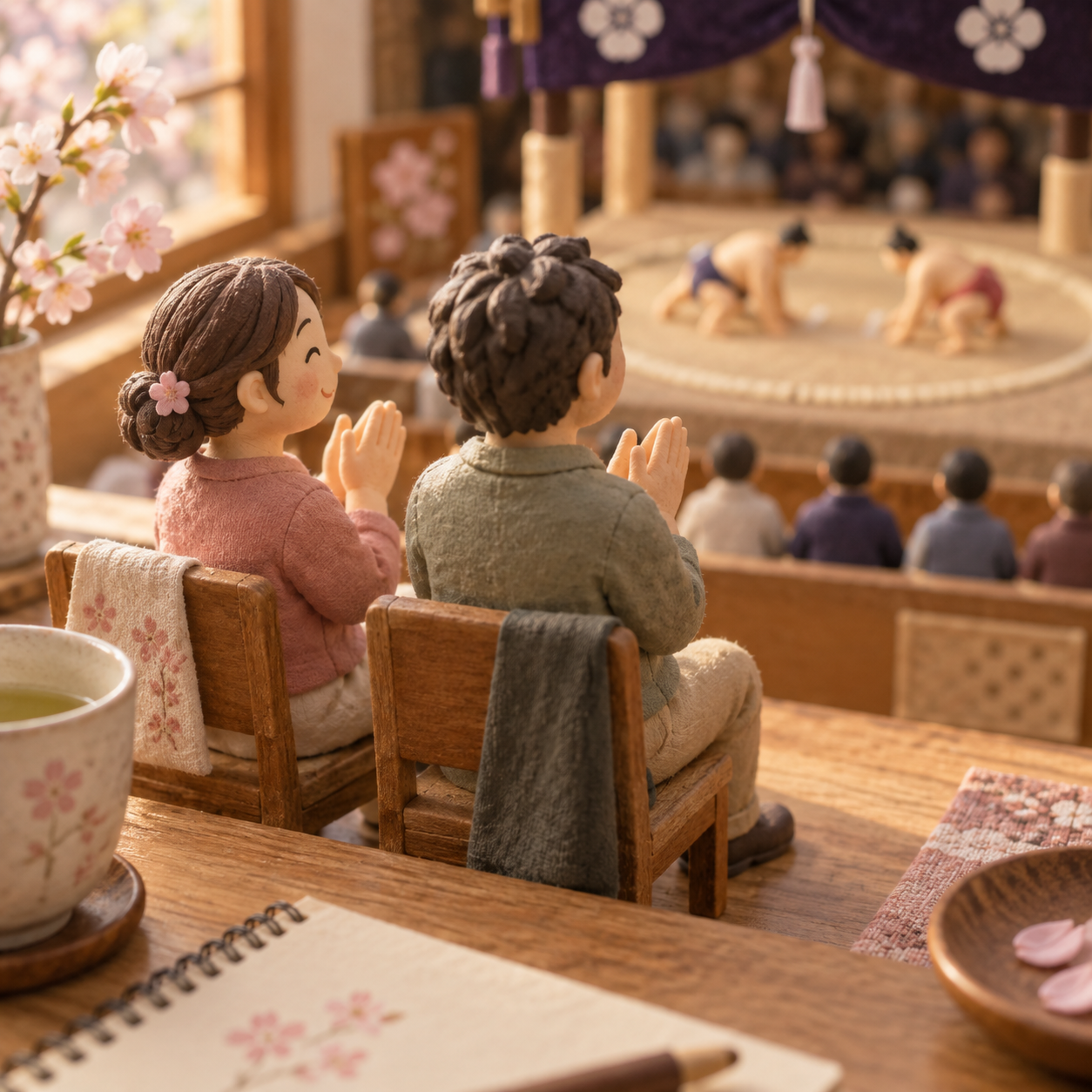
There is no second-by-second cheering timetable that a first-time spectator must memorise. Stay in your assigned seat, protect other people’s view and listen for a moment before joining in. Applause is a perfectly good starting point; you do not have to perform expertise by shouting a wrestler’s name.
The official September manners cover practical boundaries: do not block sightlines with banners or towels, do not watch from another seat, avoid moving during a bout, and do not make phone calls in the seating area. They do not publish a rule that permits a voice only at one precise second. This guide keeps that distinction clear instead of turning custom into invented law.
Applause is enough
Applause often spreads as wrestlers enter the dohyo, during pauses in the pre-bout preparation and after the result. A newcomer may follow the crowd half a beat late. Volume does not prove how long you have followed sumo.
Calling a shikona, or ring name, is also part of the live atmosphere. If you are unsure how to pronounce one, check the bout card or arena display rather than forcing it. Learning the name today and calling it confidently on another day is not a missed opportunity. It is a small relationship beginning.
A support towel should not become a wall
A towel or banner may look better in a photograph when held high, but the official notice says it must not obstruct another person’s view. Do not keep it above head height or erase the dohyo for the row behind you.
Do not move into an aisle or an empty seat for a better angle. Support sent from your actual place has its own character. From the second floor, separate calls of the same name can travel across the building; hearing them find one another is part of the arena.
Notice the quiet before the tachiai
During repeated shikiri preparations, the arena may be noisy and then suddenly still. A first-time visitor can listen before trying to lead the moment. A sumo bout does not begin with one external whistle. The wrestlers launch when their timing and breath meet, which makes the changing quiet itself worth watching.
Set the phone to silent mode and take calls outside the seating area, as the official manners request. Protecting the tension is not timid support. It lets the bout reach everyone around you.
After the result
Never throw the seat cushion. The official notice warns of injury and prohibits it. Turn surprise or frustration back into applause. Look once at the losing wrestler too: the foot that almost recovered at the edge, or the bow after defeat, can become the detail that brings you back tomorrow.
A bout watched silently was not a failure to cheer. If it makes you check the next day’s pairing or result, support has already started.
If the moment becomes uncomfortable
Use applause as the fallback whenever you are unsure about a chant, name or timing. If someone says that your towel blocks the view, lower it first and sort out the photograph later. If another spectator keeps throwing objects or a disagreement becomes unsafe, do not try to police the section yourself; ask staff for help and follow their direction. This is editorial safety advice, not a claim that every disturbance will be handled in the same way.
When You Do Not Know Whether This Is a Cheering Moment
Official spectator guidance does not publish a second-by-second timetable for applause and vocal support, so a universal answer for every moment is unknown. When unsure, stay at your seat, use brief applause, do not stand in an aisle, and do not hold anything in another spectator’s sightline. Ask event-day staff about a whistle, noisemaker or large sign rather than inferring permission. If an answer is unavailable, leave the item unused and switch to applause; you can still support a wrestler without testing an uncertain rule.
Sources
- Japan Sumo Association, September 2026 spectator notice, checked September 3, 2026, for assigned-seat, phone, banner, towel, seat-movement and cushion rules.
- Japan Sumo Association, September 2026 dohyo timetable page, checked the same date as the official place to verify the day’s sequence.
Source links used for verification
Each link was used for the corresponding claim in this article; inclusion is not a blanket endorsement of the whole page.
Article verified:
- Japan Sumo Association September 2026 spectator mannersPrimary source (as checked for this article)
- Japan Sumo Association September 2026 dohyo timetablePrimary source (as checked for this article)