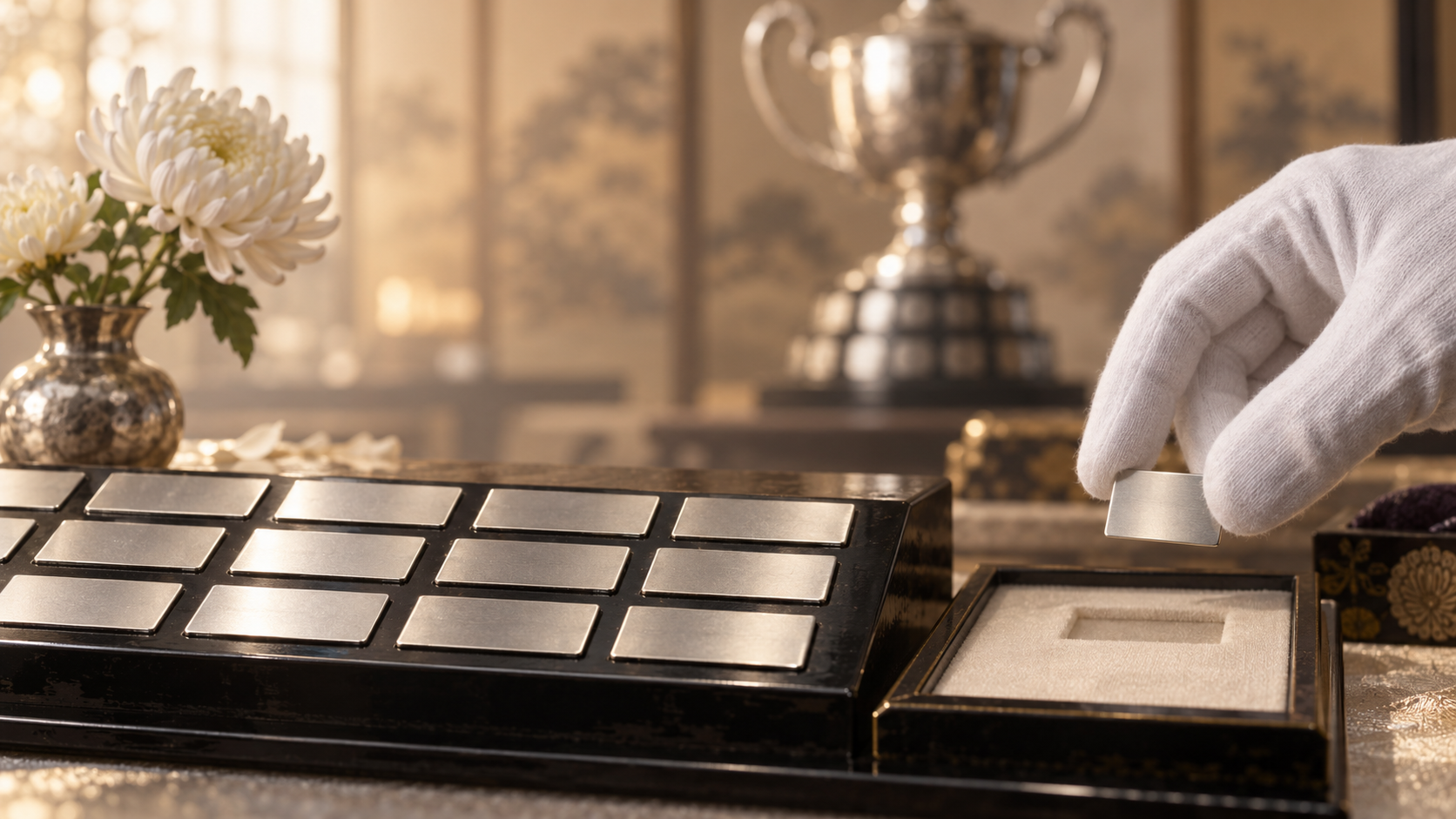
The Emperor’s Cup, or *Tenno Shihai*, is the silver challenge trophy presented to the champion of sumo’s top makuuchi division. It weighs 29 kilograms and stands roughly one metre tall. Around its base are silver plates engraved with champions’ ring names; when all 80 positions are filled, the oldest plates are removed. On the final day, look below the enormous bowl as well as at the wrestler lifting it.
The cup can look strangely manageable beside a sumo wrestler. Put the measurements back into the scene and it changes scale. Twenty-nine kilograms is not a light commemorative prop, and the base is carrying names from tournament after tournament. What first looks like a giant trophy becomes a travelling archive.
Detailed description of this diagram
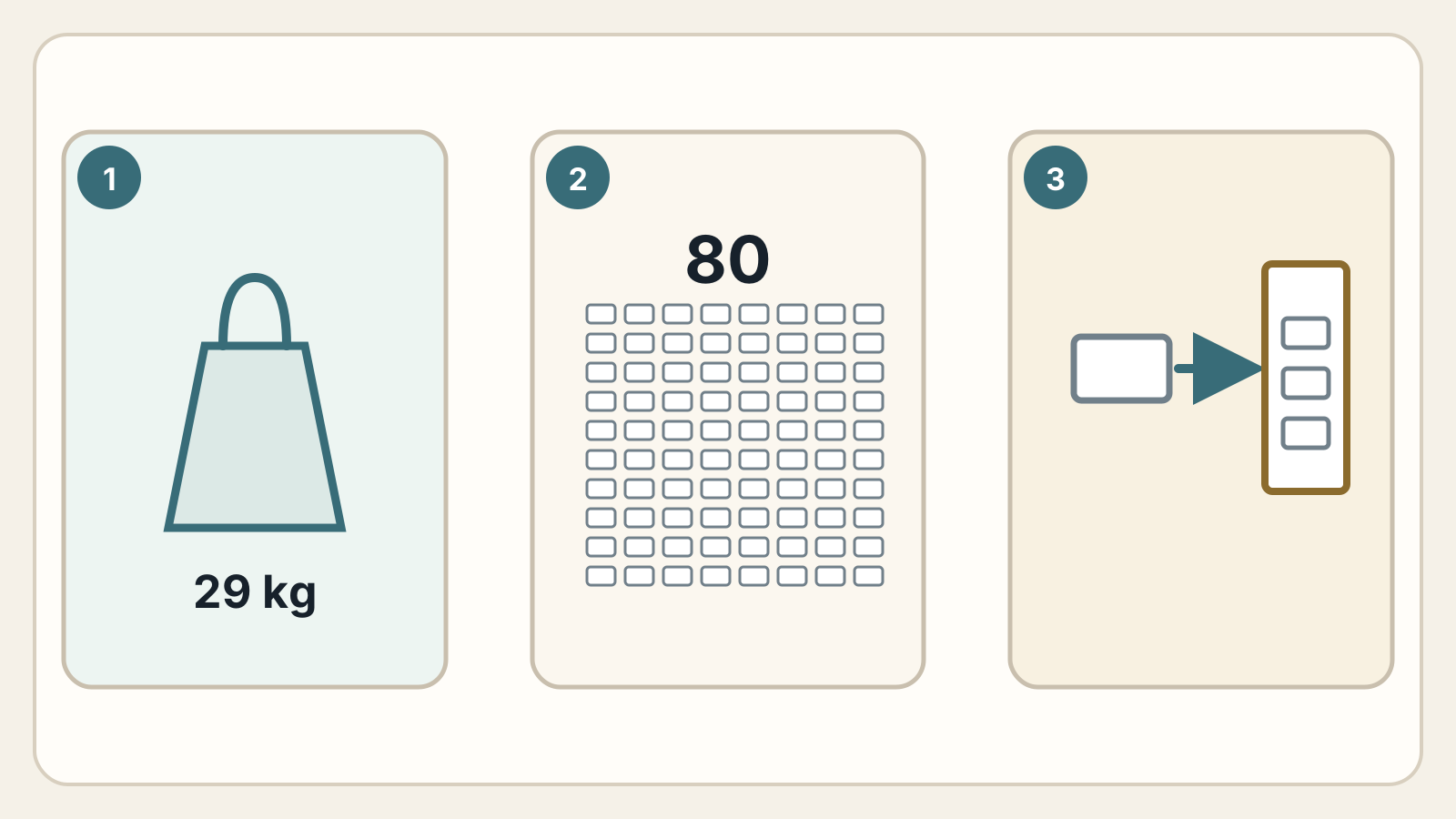
Card 1 uses a generic weight token and 29 kg for the weight on which official sources agree. Card 2 uses an eight-by-ten matrix of blank rectangles and the number 80 as a counting aid; the matrix is not the real arrangement on the base. Card 3 moves one blank rectangle by arrow into a separate empty frame, recording the museum's statement that removed old plates are mounted elsewhere. There is no cup silhouette, chrysanthemum or imperial emblem, engraving, ring name, metalwork, base, plate design, real arrangement or scale. A height comparison is omitted because official sources report 107 cm and 100.7 cm without establishing the cause of the difference.
Graphic: SUMO ARCHAEOLOGY CLUB · Figure source 1 · Figure source 2 · Figure source 3
It is the makuuchi championship cup
Grand sumo has champions in juryo, makushita, sandanme, jonidan and jonokuchi as well as makuuchi. The Emperor’s Cup is specifically awarded to the makuuchi champion. It is not a common trophy handed to every divisional winner.
The final-day ceremony includes a championship flag, the Prime Minister’s Cup and awards from governments, organisations and companies. A first-time viewer does not need to identify the entire procession. Start with one object: the huge silver bowl and its substantial base.
Official sources disagree slightly about the height
Two Association quiz pages give the cup’s height as 107 centimetres and its weight as 29 kilograms. A 2016 Sumo Museum exhibition catalogue records a height of 100.7 centimetres, a mouth diameter of 33 centimetres and the same 29-kilogram weight.
Those are primary sources from the same organisation, yet the heights differ by 6.3 centimetres. The material available does not establish whether the difference comes from measurement conventions, rounding or a transcription error. We therefore use the honest description “roughly one metre” instead of silently selecting one figure. The disagreement is a useful reminder that even an official object needs source comparison.
Eighty engraved plates turn the base into a record
The lower part of the cup carries silver plates engraved with the ring names of makuuchi champions. The Association says there are 80 plate positions. When the set is full, older plates are removed; the museum explains that removed plates are then mounted in a separate frame.
The history is not erased when a plate leaves the cup. It moves into another display. If the camera reaches the base during the ceremony, do not worry about reading every Japanese character. Simply notice the repeated metal rectangles. If the makuuchi champion is officially decided and a plate is added, that tournament’s ring name joins the physical sequence.
The cup emerged from an imperial sumo exhibition in 1925
The Sumo Museum traces the cup to 29 April 1925, when the Prince Regent, later Emperor Showa, watched a Tokyo sumo exhibition and provided an imperial monetary gift for the promotion of sumo. The Tokyo association used the funds to create a championship cup. After changes to its name and chrysanthemum design, the trophy began to be awarded to makuuchi champions in its approved form in the summer tournament of 1927.
Another Association account connects this episode to the merger of the Tokyo and Osaka sumo associations and the unification of professional sumo. The object therefore opens onto more than a list of winners. Its origin sits inside the institutional history of how modern grand sumo became one national organisation.
The original travels; the champion later receives a replica
The full-size silver cup is passed from champion to champion. It does not become the permanent private property of the wrestler shown lifting it. The Sumo Museum says a replica is later presented to a makuuchi champion.
This resembles the championship flag in one respect: both are travelling awards. They record winners differently. The cup uses engraved silver plates, while the flag carries long fabric name strips. Watching both objects reveals two parallel archives—metal and cloth—inside one ceremony.
Watch the base after the lift
When the champion receives the cup, notice his arms taking the 29-kilogram load. If the broadcast cuts closer, let your eyes travel down to the base. If a plate is added after the official championship result, one of the 80 positions records that tournament as a new layer of sumo history.
Fifteen days of immediate, uncertain competition end in a remarkably durable object. The cup moves on to another tournament; the ring name remains in the row. Once you see how quickly today’s result becomes museum material, the award ceremony feels less like an appendix and more like the final page of the tournament.
Sources
- Japan Sumo Association, Sumo Quiz No. 1329 on the Emperor’s Cup and its nameplates (published 29 August 2025; checked 3 September 2026)
- Japan Sumo Association, Sumo Quiz No. 20 on the cup’s weight and dimensions (published 28 January 2022; checked 3 September 2026)
- Sumo Museum, “Grand Sumo Prizes—Honouring the Winners” (published 19 April 2016; checked 3 September 2026)
- Japan Sumo Association, Sumo Quiz No. 661 on the cup’s historical setting (published 31 October 2023; checked 3 September 2026)
Source links used for verification
Each link was used for the corresponding claim in this article; inclusion is not a blanket endorsement of the whole page.
Article verified:
- Japan Sumo Association Sumo Quiz No. 1329: the Emperor's Cup nameplatesPrimary source (conflicting details noted)
- Japan Sumo Association Sumo Quiz No. 20: the weight of the Emperor's CupPrimary source (conflicting details noted)
- Sumo Museum: Grand Sumo Prizes—Honouring the WinnersHistorical primary source (record from that period)
- Japan Sumo Association Sumo Quiz No. 661: the cup and the Tokyo–Osaka mergerHistorical primary source (record from that period)