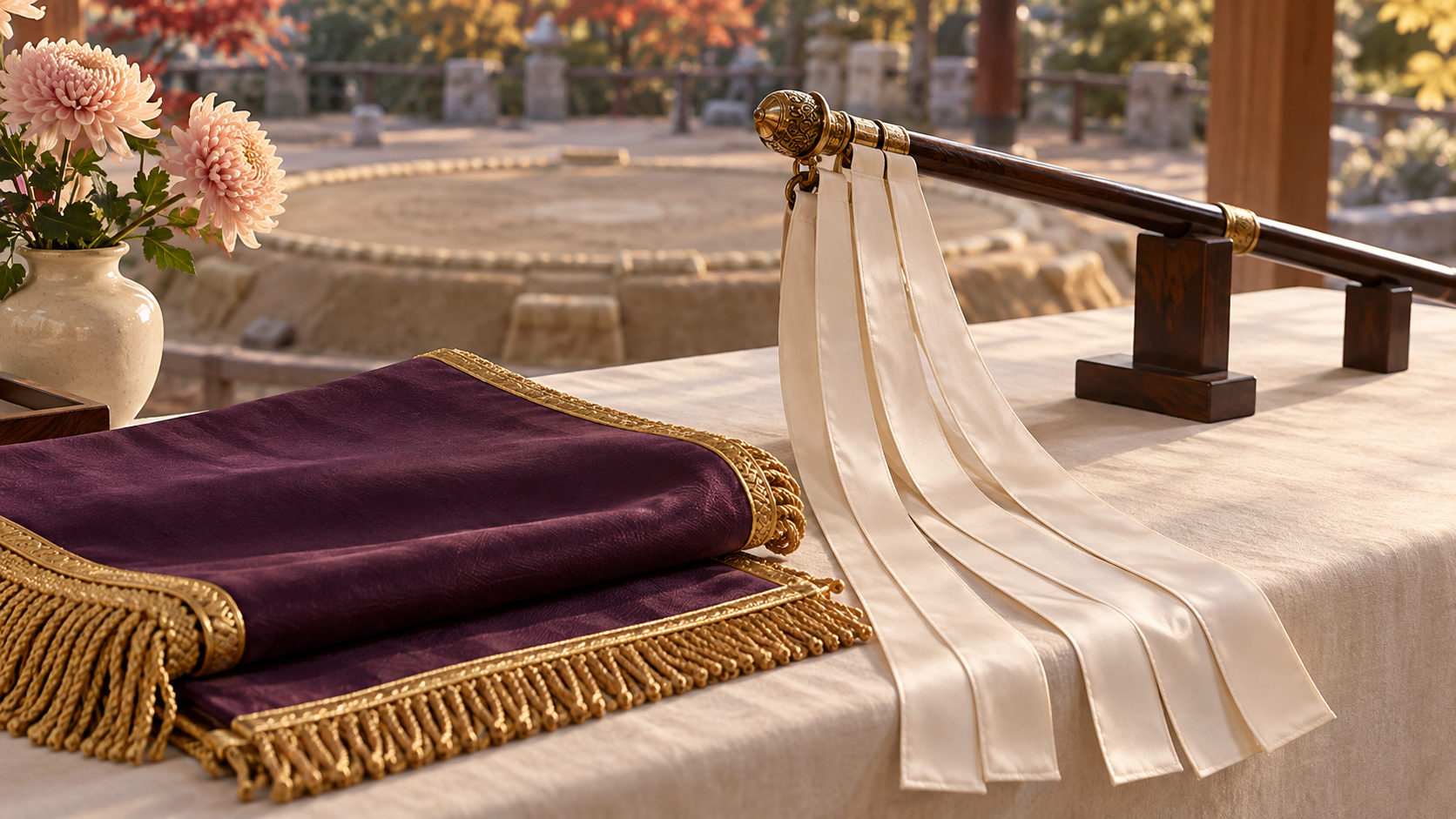
Sumo’s top-division championship flag does not have each new winner embroidered into its main design. Long fabric strips attached near the top record the tournament and wrestler’s name, and the flag carries roughly two years of them. It is a challenge prize: after being awarded on the final day, it returns on day one of the next tournament following the yokozuna ring-entering ceremony.
The central design naturally takes over the screen during the awards. The more revealing detail hangs above it. Several narrow strips place recent champions side by side, one tournament at a time. The flag belongs less to a single winner than to the journey between winners.
Detailed description of this diagram
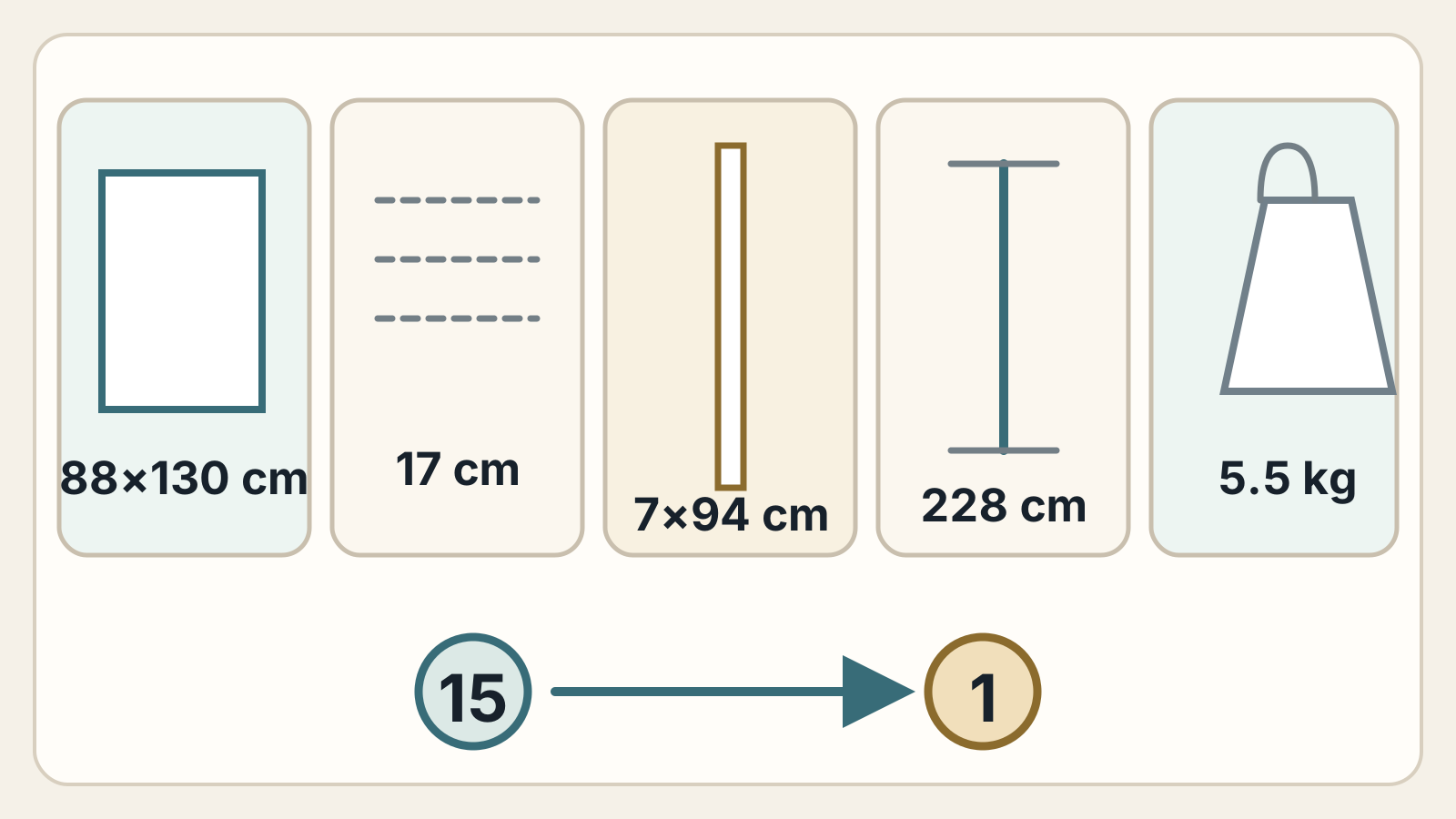
Five independent upper cards give the published flag-cloth, fringe, record-strip, pole-inclusive height and total-mass values. Only the blank flag and strip rectangles preserve their respective 130:88 and 7:94 width-to-height ratios; they remain separate and do not assemble a recognisable flag. Fringe position on three sides, attachment to the pole, strip count and placement, lettering, emblem, colour and material are omitted. A lower arrow from 15 to 1 means awarded on the tournament's final day and returned on the next tournament's opening day. It is not an elapsed-day count, transport route, venue location or exact ceremony time.
Graphic: SUMO ARCHAEOLOGY CLUB · Figure source 1 · Figure source 2
Each strip records a tournament and champion
The Japan Sumo Association says a strip measuring 7 by 94 centimetres is attached along the upper part of the flag for each champion. The set shows about two years of winners. Names are not stitched one by one into the body of the flag or carved into its pole.
From a distant arena seat, the Japanese writing may be impossible to read. The silhouette is enough: look for several slim bands descending from the top. The newest champion shares the object with a short sequence of predecessors. Six tournaments stop looking like six isolated events and start looking like one rolling record.
The pole is taller than most people
The Association records the flag itself as 88 centimetres high and 130 centimetres wide. Seventeen-centimetre fringe, called *baren* in Japanese, runs along three sides. Its pole is 228 centimetres long and the complete object weighs 5.5 kilograms.
Those dimensions restore scale that television can hide. A large wrestler or flag bearer can make the object look ordinary, but the pole rises well above most adults. Movement matters too: the person carrying it must control a broad fabric surface on a pole more than two metres long.
The current flag is the fourth version and has been in use since the January 1991 tournament. The official page also records its production cost, but that historical figure should not be read as today’s replacement price or as a market valuation.
The flag returns on the next tournament’s opening day
This is not a trophy that simply disappears into the champion’s home. The Association describes it as a travelling award. On day one of the next tournament, it is returned during the middle-division interval after the yokozuna ring-entering ceremony.
That creates a satisfying piece of continuity. On the final day, the flag leaves with the champion. At the next opening, it comes back carrying the previous result into a new fifteen-day contest. A tournament does not begin from a perfectly blank page; one of its first ceremonial acts closes the loop from the last one.
Schedules can vary, and a viewer should check the official programme for the particular tournament rather than assume every event outside the six annual grand tournaments uses the same ceremony. The return described here belongs to the grand-sumo championship flag.
Cloth and silver remember victory differently
The Japan Sumo Association’s Sumo Quiz No.1329 describes engraved silver nameplates on the Emperor’s Cup and says that, at 80 plates, the oldest are removed. The Sumo Museum’s 2016 exhibition explains that removed plates are mounted in a frame. The championship flag records winners on fabric strips, described in a separate official explainer.
You do not need to decide which one is the “real” championship trophy. Grand sumo’s award ceremony deliberately contains several objects. Choose one detail today—the strips on the flag—and leave the other cups and prizes for another tournament. That is a much kinder way to learn a ceremony with many unfamiliar presentations.
Photograph from your seat and follow its rules
The sources about the flag do not establish how closely spectators may approach it, whether photography is allowed, or which seat-specific device limits apply. Do not infer permission. Check the official guidance for that venue, seat and date; if it is unavailable or unclear, watch from your assigned place and do not enter the ceremony route or approach the flag.
If a long lens or close broadcast shot never reveals the writing, nothing essential is lost. Count the hanging bands or notice which one looks newest. The object’s motion between tournaments is more important than successfully decoding every character.
Watch it leave—and then watch it return
On the final day, stay long enough to see the championship flag presented. At the next tournament, if you are watching from the beginning of the top-division programme, remain alert after the yokozuna ring-entering ceremony. The same object’s return turns a calendar date into a relay.
Rankings and records draw a sharp line between one tournament and the next. Material culture crosses it. The flag arrives with earlier names still attached and waits for another. Once you notice that round trip, the tournament rhythm becomes something you can see, not merely a schedule you have memorised.
Keep More Than One Interpretation Open
We separate what the official or collection source establishes from our observation. A ritual, object or posture may have another interpretation or theory across periods, regions and explainers. When primary evidence does not establish a single origin or meaning, we leave it unknown or contested rather than turn visual resemblance into historical fact.
Sources
- Japan Sumo Association, Sumo Quiz No. 666 on the championship flag, its dimensions, name strips and return ceremony (published 5 November 2023; checked 3 September 2026)
- Sumo Museum, “Grand Sumo Prizes—Honouring the Winners” (published 19 April 2016; checked 3 September 2026)
Source links used for verification
Each link was used for the corresponding claim in this article; inclusion is not a blanket endorsement of the whole page.
Article verified:
- Japan Sumo Association Sumo Quiz No. 666: championship-flag strips and return ceremonyPrimary source (as checked for this article)
- Sumo Museum: Grand Sumo Prizes—Honouring the WinnersHistorical primary source (record from that period)