For kirikaeshi, a wrestler places his knee against the outside of the opponent’s opposite knee and twists him backwards. The Japan Sumo Association gives a particularly useful contrast with sotogake: in kirikaeshi, the wrestler does not hook the opponent’s knee with his foot, and his own foot remains on the clay. In the next bout, when the legs cross, ignore the fall and watch whether the attacker’s sole lifts to hook or remains planted while the knee makes contact.
Two wrestlers turn in a chest-to-chest grip. Their knees meet, and one falls backwards. From a distance it can look like sotogake, or simply like feet became tangled. Kirikaeshi places an important official distinction at ground level: whether the attacker’s foot remained on the clay rather than hooking. It is a clue, not a sufficient test without the decisive action and official result.
A knee presses from the outside
The Association explains the left-side version by placing the attacker’s left knee against the outside of the opponent’s right knee; the right-side version mirrors that arrangement. The opponent is then twisted backwards. For a viewer, “opposite knee” is easier to retain than reciting right and left while both wrestlers rotate.
The important distinction is between pressing and hooking. In kirikaeshi, the attacking foot stays planted. The knee contacts the outside of the opponent’s knee while the upper body supplies the backward twist. The foot does not curl around the leg and pull it away.
An arena angle may conceal the entire sole. If so, see whether the attacker’s ankle travels around the opponent’s lower leg or whether the knees themselves seem to form the contact point. Keep the result tentative until the official announcement.
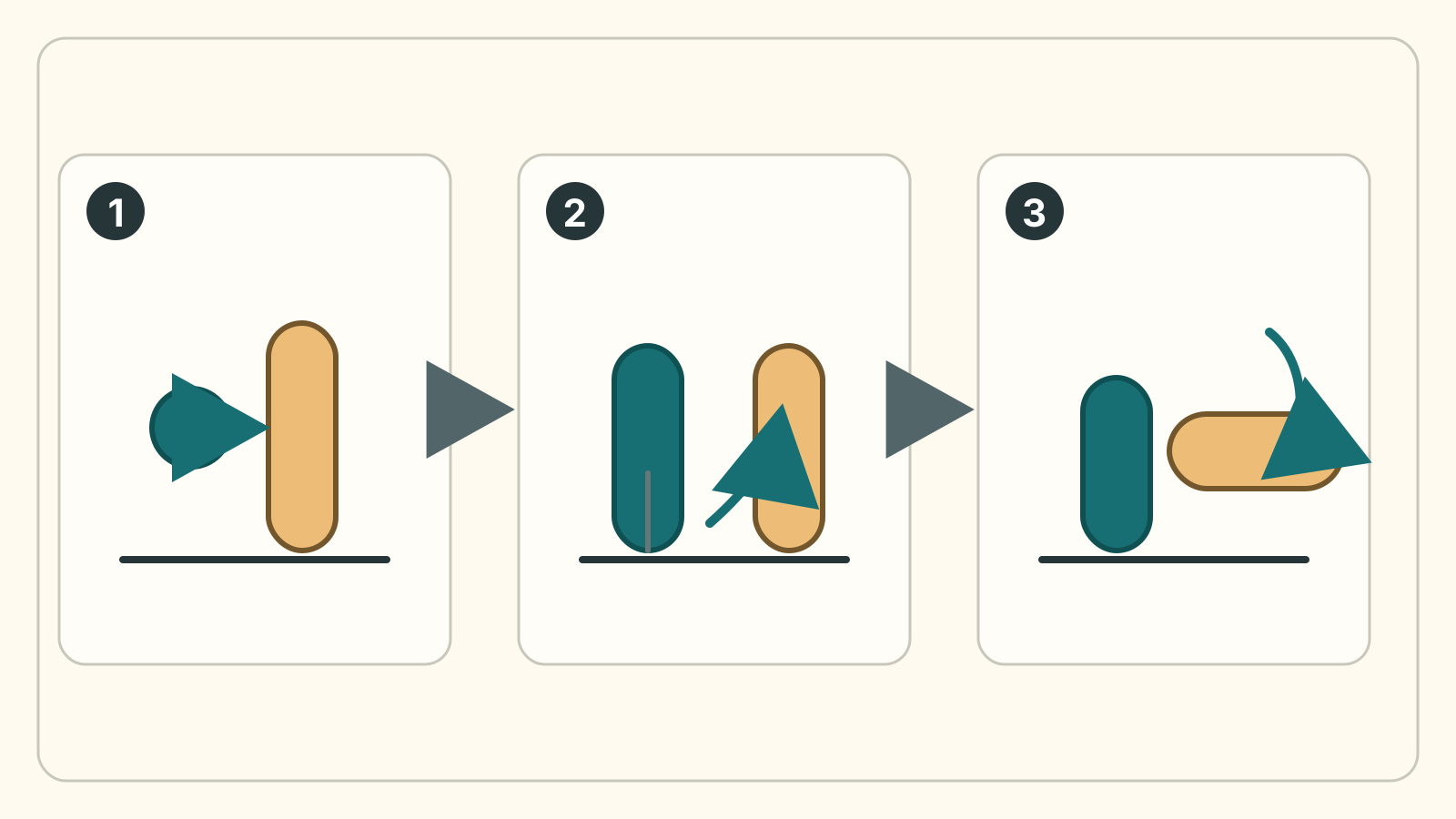
Detailed description of this diagram
Card 1 places a blue contact dot outside a gold support bar on a ground line, recording only the opposite-knee outside relation. Card 2 keeps blue and gold support bars touching the ground line and uses a curved arrow for the backward-twist relation. Card 3 changes the gold token to a horizontal categorical down state. The support bars, dot, ground line and curve are not legs, knees or feet and encode no joint angle, hook clearance, stance width, laterality, balance or fall path.
Graphic: SUMO ARCHAEOLOGY CLUB · Figure source 1 · Figure source 2 · Figure source 3
Sotogake lifts and hooks the leg from outside
Sotogake also attacks the opponent’s opposite-side leg from the outside. In the official definition, the wrestler hooks his right foot around the opponent’s left leg, or his left foot around the opponent’s right, and pulls that leg to topple him backwards.
That shared outside position explains why the silhouettes resemble each other. The differentiator supplied by the Association is the attacker’s foot. If it leaves its supporting role, wraps around the opponent’s leg and pulls, think sotogake. If it stays rooted while the knee presses outside and the bodies twist, think kirikaeshi.
“I saw contact on the outside” is therefore not the full test. Outside contact can appear in both. Ask what the foot did after arriving there.
Uchigake enters from the inside
Uchigake also pairs the attacker’s right foot with the opponent’s left, or the left with the right. The foot enters from the inside of that leg and hooks or reaps it so the opponent loses his balance.
Imagine one opponent’s leg as a post. Did the attacking foot enter from the space between the wrestlers’ legs? That points towards uchigake. Did a foot circle the outer side and hook? That points towards sotogake. Did the foot remain on the clay while the attacker’s knee pressed the outside of the post? That is the kirikaeshi clue.
The screen’s left and right will change as the wrestlers turn. “Inside, outside, or planted” survives that change better than a memorised television direction.
Do not decide from the landing posture
Kirikaeshi and sotogake can both leave the opponent falling backwards. Whether his back, hip or hand reaches the clay first does not identify the decisive action. A kimarite is not a label for the final pose; it identifies how the victory was produced.
There will be replays in which the decisive foot is hidden. Saying “the knees were visible, but I could not see the sole” is more accurate than forcing an answer from the fall alone. Knowing what evidence is missing is a genuine step in learning to watch.
One thing to watch in the next bout
When a yotsu grip brings the legs close, choose one sole—the wrestler who seems to be initiating the turn. If that sole remains in contact with the clay while his knee meets the outside of the opponent’s opposite knee, predict kirikaeshi. If the foot lifts, hooks around the leg and pulls, consider sotogake.
The defender may shift his knee away before anything is completed. That small escape is worth seeing. Above the waist, the wrestlers are fighting for a belt grip; below it, one planted leg is trying to become a lever. Kirikaeshi makes the floor itself visible. Once the clay becomes part of your evidence, a crowded tangle of legs turns into a sharply drawn contest over one point of support.
Similar Motion Does Not Set the Official Technique
A hand action or fall may look similar while the recorded kimarite differs according to the decisive action, sequence of balance loss and whether a body part touched down or crossed the ring first. Do not settle the difference between a similar technique, non-technique or foul from one camera angle; use the official result for that bout. A schematic marks viewing cues, not a substitute judges’ decision.
Evidence limits and event-day fallback
Confirmed fact: The Association describes kirikaeshi as placing the knee against the outside of the opponent’s opposite knee, keeping the attacker’s foot on the clay rather than hooking, and twisting the opponent backwards.
What remains unknown: A seat or camera may hide the sole, knee contact and decisive action. Landing posture alone cannot settle sotogake, uchigake, a non-technique, pain or injury.
Reasoned inference: Comparing an apparently planted support with an apparently lifted outside hook can narrow a viewing hypothesis. Confidence is medium; appearance is not the official judging test.
Editorial suggestion: Rather than memorise screen-left/right, observe target-leg inside/outside and one support contact. This is neither coaching nor a judging procedure.
Fallback: If the sole or contact is hidden, stop at ‘possibly kirikaeshi’ and check the arena announcement or official result.
Sources
- Japan Sumo Association, kimarite explanation for kirikaeshi (checked 3 September 2026)
- Japan Sumo Association, kimarite explanation for sotogake (checked 3 September 2026)
- Japan Sumo Association, kimarite explanation for uchigake (checked 3 September 2026)
Source links used for verification
Each link was used for the corresponding claim in this article; inclusion is not a blanket endorsement of the whole page.
Article verified:
- Japan Sumo Association kimarite: kirikaeshiPrimary source (as checked for this article)
- Japan Sumo Association kimarite: sotogakePrimary source (as checked for this article)
- Japan Sumo Association kimarite: uchigakePrimary source (as checked for this article)