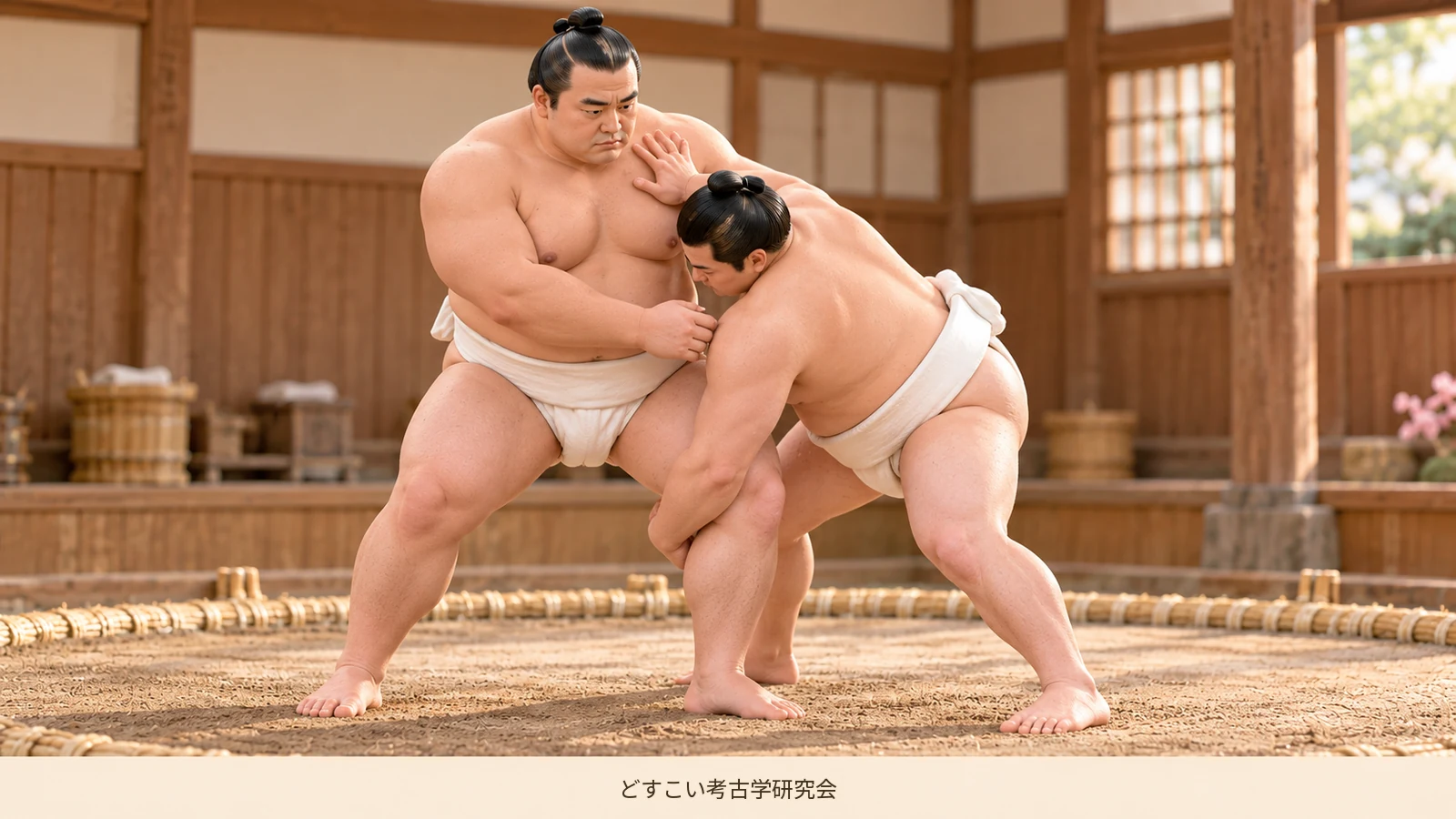
In watashikomi, the winner wraps one arm around the outside of an opponent’s knee or thigh and pulls it inward. His other hand pushes the opponent, and he commits his body weight to topple him. A hand touching a leg is not enough, and neither is a simple push-down. Look for two jobs happening together: one arm draws the leg in while the other hand pushes. In the next bout, if one hand drops towards a knee at the edge, watch only where the other hand goes.
Near the tawara, one wrestler suddenly becomes low. An arm circles a leg, the two bodies overlap, and both may appear to fall together. Watashikomi is easy to file mentally as “some kind of leg grab.” Its charm is more precise: the wrestler splits one attack between two hands at two different heights.
The official definition has four connected actions
The Japan Sumo Association describes watashikomi as wrapping one hand around the outside of the opponent’s knee or thigh and pulling it inward. The other hand pushes the opponent; the attacker then leans his weight into the finish and brings the opponent down.
Do not identify the technique from the location of one hand alone. Ask whether one arm came from the outside of the knee or thigh and drew the leg in. Then ask whether the other hand pushed the opponent and the attacker committed his body weight. The official description connects those actions rather than treating a brief touch at the leg as the whole technique.
The grip can disappear behind two large bodies, especially from a side-on arena seat. If it does, use the low shoulder, the inward movement of one leg and the opponent’s backward tilt as provisional clues. The announced kimarite remains the answer; your view supplies a hypothesis, not a replacement for the judges’ angle.
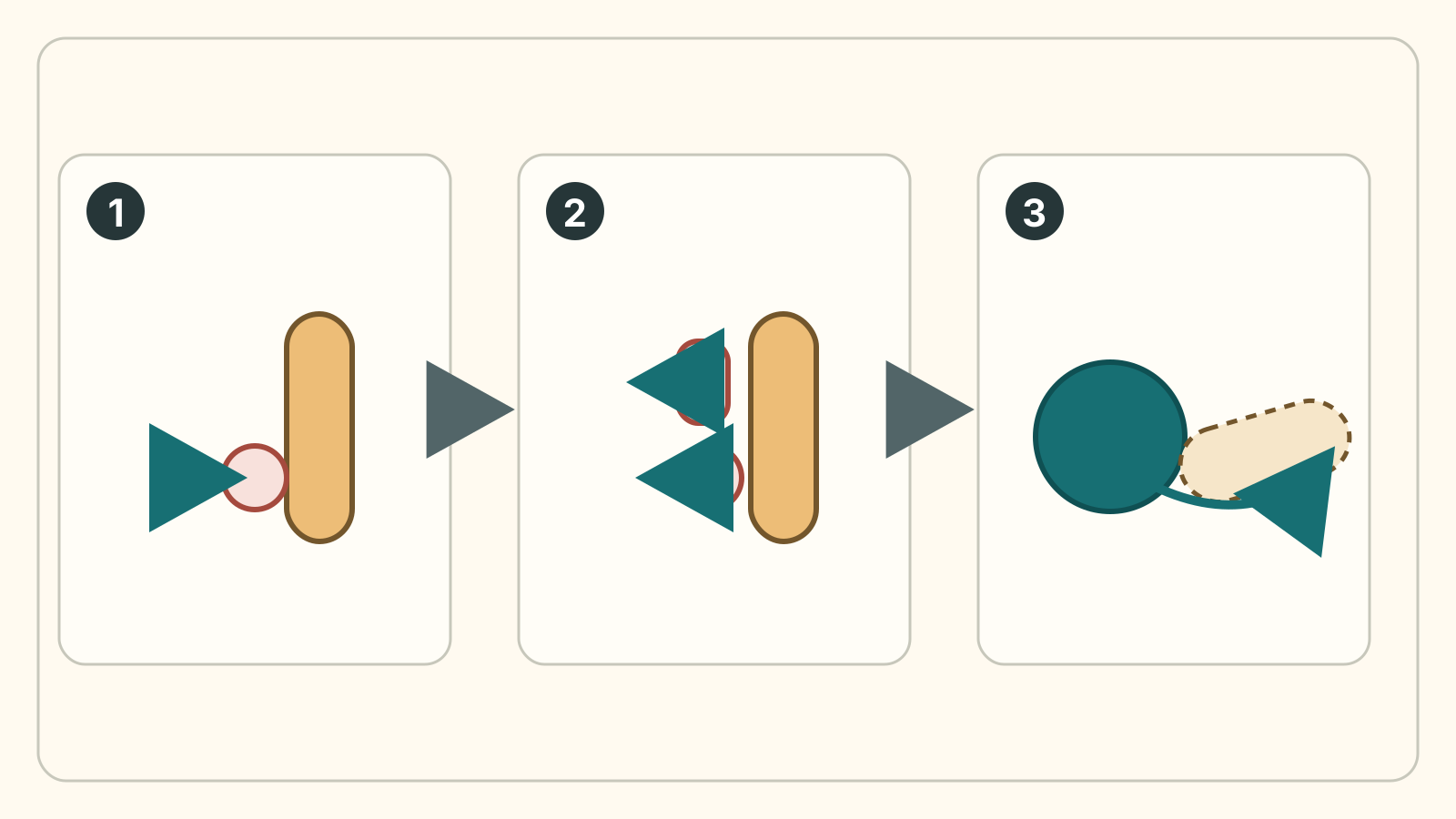
Detailed description of this diagram
Card 1 uses a lower gold support bar, red contact dot and inward blue arrow for the first hand's draw role. Card 2 preserves that lower role and adds a separate upper contact band and push arrow for the other hand. Card 3 overlaps a blue winner token with a horizontal gold down-state token for the weight-over result. Lower bar, contacts, arrows and overlap encode no knee, thigh, hand placement, grip, spatial direction, force, body weight, balance, fall path, injury or execution method.
Graphic: SUMO ARCHAEOLOGY CLUB · Figure source 1 · Figure source 2 · Figure source 3
Watashikomi is not ashitori
Ashitori is another technique that attacks one leg. In the Association’s definition, the attacker gets underneath the opponent, embraces one leg with both hands, and either topples him or takes him outside the ring.
That gives a beginner a practical contrast. In watashikomi, one arm attends to the knee or thigh while the other hand pushes the opponent. In ashitori, both hands gather around the same leg. Rather than trying to judge exactly how low the wrestler crouched, count the hands: did both converge on one leg, or did one take the leg while the other performed the push?
One hand may be hidden, so “I saw a leg grab; therefore ashitori” is too quick. Wait for the second hand.
Watashikomi is not simply oshitaoshi either
Oshitaoshi, or push-down, uses one or both hands in a *hazu* shape to push the opponent’s body down. Watashikomi includes a pushing hand, so the upper half of the finish can resemble oshitaoshi.
The leg action separates them. Watashikomi adds the outside wrap around the knee or thigh and the inward pull. That action is not part of the official oshitaoshi definition. The question is not where the opponent finally lands. It is whether one leg was drawn inward while the other hand pushed and the attacker committed his weight.
A kimarite does not diagnose an injury
Once you can see an arm around a knee, it is tempting to speculate about pain, damage or intent. A kimarite name describes the decisive action; it is not a medical finding. Do not infer an injury from the replay alone. If a wrestler’s condition becomes consequential, wait for a verifiable statement from the wrestler, his stable or the Association.
This restraint does not make the technique less dramatic. It lets us be specific about what the video shows without inventing what it cannot show.
One thing to watch in the next bout
At the edge, notice when one wrestler’s hand drops to the outside of a knee or thigh. Then leave that low hand and look once at his other hand. If one arm pulls the leg inward while the other hand pushes the opponent and the attacker leans in, predict watashikomi.
The attempt may fail. The defender might withdraw his leg or keep his chest high enough that the attacker cannot load weight into the finish. That is still a discovery. Sumo can look like one great contest of mass, yet watashikomi reveals a tiny division of labour: one hand moves the base and the other moves the tower. Once you have seen both arrows, the whole body begins to make sense.
Similar Motion Does Not Set the Official Technique
A hand action or fall may look similar while the recorded kimarite differs according to the decisive action, sequence of balance loss and whether a body part touched down or crossed the ring first. Do not settle the difference between a similar technique, non-technique or foul from one camera angle; use the official result for that bout. A schematic marks viewing cues, not a substitute judges’ decision.
Sources
- Japan Sumo Association, kimarite explanation for watashikomi (checked 3 September 2026)
- Japan Sumo Association, kimarite explanation for ashitori (checked 3 September 2026)
- Japan Sumo Association, kimarite explanation for oshitaoshi (checked 3 September 2026)
Source links used for verification
Each link was used for the corresponding claim in this article; inclusion is not a blanket endorsement of the whole page.
Article verified:
- Japan Sumo Association kimarite: watashikomiPrimary source (as checked for this article)
- Japan Sumo Association kimarite: ashitoriPrimary source (as checked for this article)
- Japan Sumo Association kimarite: oshitaoshiPrimary source (as checked for this article)