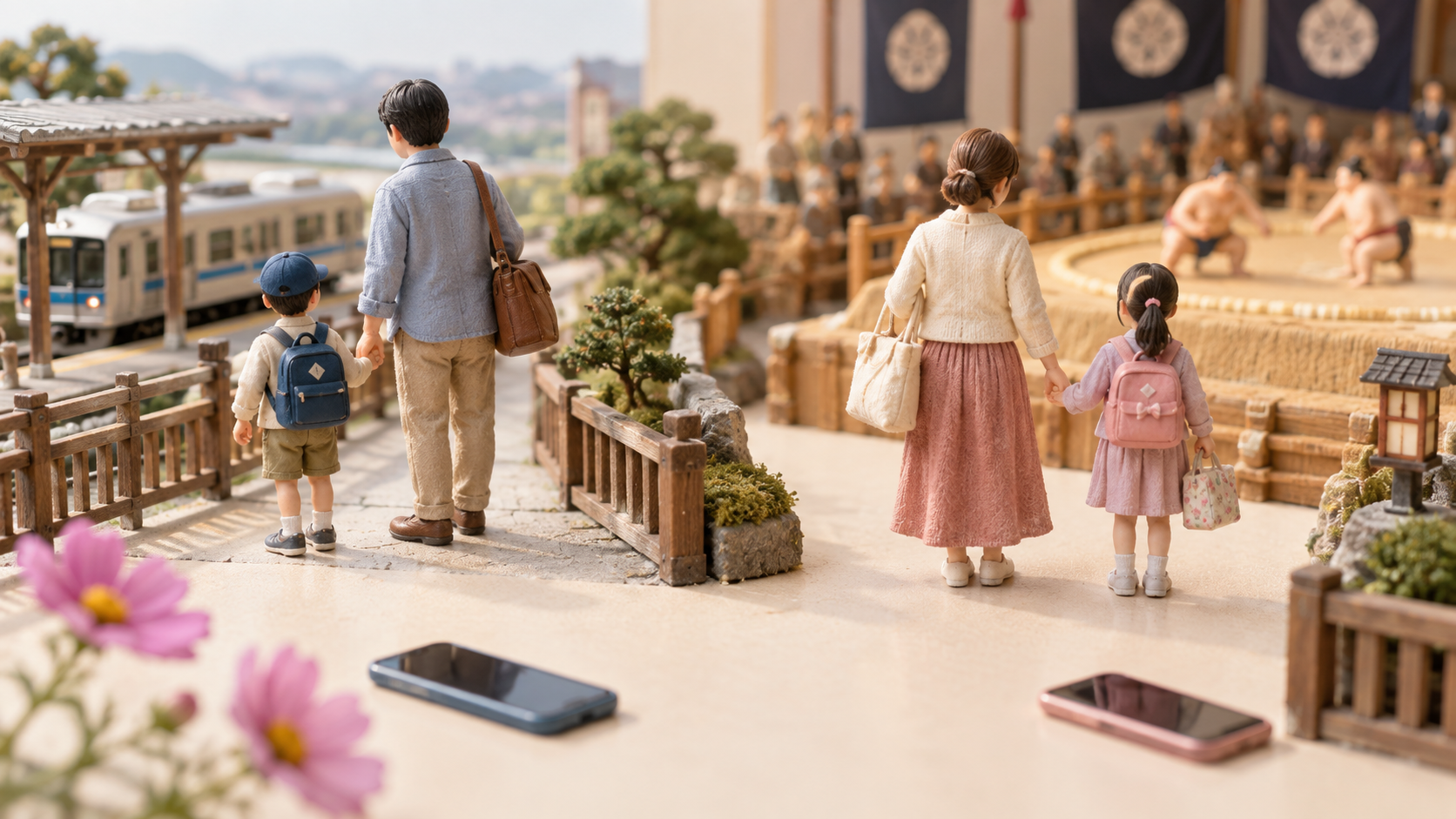
If one sibling may need to leave Ryogoku Kokugikan early, make two valid plans before admission: everyone exits together, or one adult leaves with the child while the other adult and child continue watching. In the split plan, each team carries its own valid tickets, phone, money, keys, route and contact details. Never make a child wait alone in a seat, circulation area or outside meeting point while adults negotiate the next move.
Our short-visit plan with a child assumes the family’s whole visit becomes shorter. This guide handles the more awkward moment when a younger child has had enough but an older sibling is still waiting for a favourite wrestler.
Make both endings successful
If the first discussion happens after a child is exhausted, ticket cost and adult expectations enter the negotiation. Decide two branches the previous day:
- Leave together: name the signal, route home and programme moment you will give up.
- Split safely: name the departing adult and child, the staying adult and child, and the final reunion point.
Age does not establish who can tolerate a long session. Use the child’s current sleep, health, sensory response and ability to wait. For September 2026, anyone aged four or older on the visit date needs a ticket. Check the eligibility attached to any child price or family product; do not simply subtract a ticket because one visitor is small.
Divide the digital and practical essentials before entry
Groups using QR tickets must distribute them to each visitor before arrival. The Association says undistributed QR tickets, screenshots and printed QR images are not accepted. Do not leave every family ticket on the staying adult’s phone. Follow the official ticket service’s approved process, especially where a child does not carry a device. Our QR ticket guide provides the pre-arrival checklist without inventing a family exception.
The departing team also needs its own transport card or cash, accommodation or home key, essential personal items and emergency contacts. Both adults should be able to retrieve the final address and meeting plan if one phone loses power or connectivity.
Decide whether the departing team is finished for the day
September 2026 permits re-entry once. If the departing adult and child are going home, do not complicate the exit by promising a return. If they may take a break outside and come back, ask gate staff about the procedure and the ticket or paper stub before crossing the exit. Do not tell a child that the building can be entered and left repeatedly.
The family members who remain must continue using their own assigned places. An empty seat is not automatically available to a different relative, and an aisle or doorway is not a substitute viewing area. Ask an attendant if an adjustment is genuinely needed; do not improvise from what looks unoccupied.
Use the end of a bout—unless waiting is unsafe
The spectator notice asks people not to move between seats during a bout. When the situation allows, tell the child, “We will leave after this bout,” and gather belongings before the next pair begins. That gives a short, visible boundary rather than an indefinite promise.
Urgent toileting, nausea, acute pain or severe distress should not be delayed for etiquette. Ask nearby spectators for room, move carefully and follow staff directions. A particular row or crowd condition cannot be guaranteed to make an early exit easy.
Decide whether the staying team will walk to the exit or say goodbye at the seat. A phone-free reunion is covered in the offline meeting plan. Where a train or appointment creates a hard deadline, use the early-departure guide to include station and transfer margin.
Let the family bring home two versions of sumo
Before separating, give each team one small thing to notice. The staying team might watch a favourite wrestler’s tachiai. The departing team might listen for the final yobidashi call they hear on the way out. When everyone meets again, exchange those details instead of testing children on the winners.
The family did not fail to share the whole afternoon. It collected two views of the same day. The child who left early still owns a piece of sumo—and that piece may be exactly what makes another, shorter visit feel possible.
The night-before split checklist
- Each visitor’s ticket type, assigned place and approved QR delivery
- The signal for everyone leaving and the signal for splitting
- The adult and child in each team
- A phone, keys, money, essential personal items and route for both teams
- A final reunion point that does not depend on mobile service
- One thing each team wants to notice
Finish the two-team plan at the front door
The night before, say each team’s adult, child, valid ticket, phone, money, key, medicine, coat and route home aloud. The departing team needs its exit and station direction; the remaining team needs an adult, programme limit and return. Add one rule for lost connectivity: each team goes home by its own plan and no child is left at a meeting point waiting for contact.
After entry, both adults should see the route from seat to exit, restroom and staffed point. A child’s pain, nausea, sensory distress, sleep or toileting outranks ticket cost and an adult’s desired bout. Unless the need is urgent, use a break between bouts and keep the aisle clear while dividing belongings.
Do not infer re-entry, QR reuse or a safe outdoor waiting place beyond the current official information. If the departing team cannot return, phones fail or transport is disrupted, use the pre-agreed separate journeys home. This does not promise a reunion; it is an editorial fallback that prevents a child being left alone when reunion fails.
Sources
- Japan Sumo Association, September 2026 Tokyo spectator notice, checked September 3, 2026, for age-four tickets, QR distribution, once-per-day re-entry and movement during bouts.
- Japan Sumo Association, September 2026 Tokyo price list, checked the same day for the existence of eligibility conditions attached to child and family ticket products.
- Japan Sumo Association spectator contract, checked the same day for valid admission, assigned seating and prohibited viewing in circulation areas.
Source links used for verification
Each link was used for the corresponding claim in this article; inclusion is not a blanket endorsement of the whole page.
Article verified:
- Japan Sumo Association September 2026 Tokyo spectator noticePrimary source (as checked for this article)
- Japan Sumo Association September 2026 Tokyo price listPrimary source (as checked for this article)
- Japan Sumo Association spectator contractPrimary source (as checked for this article)