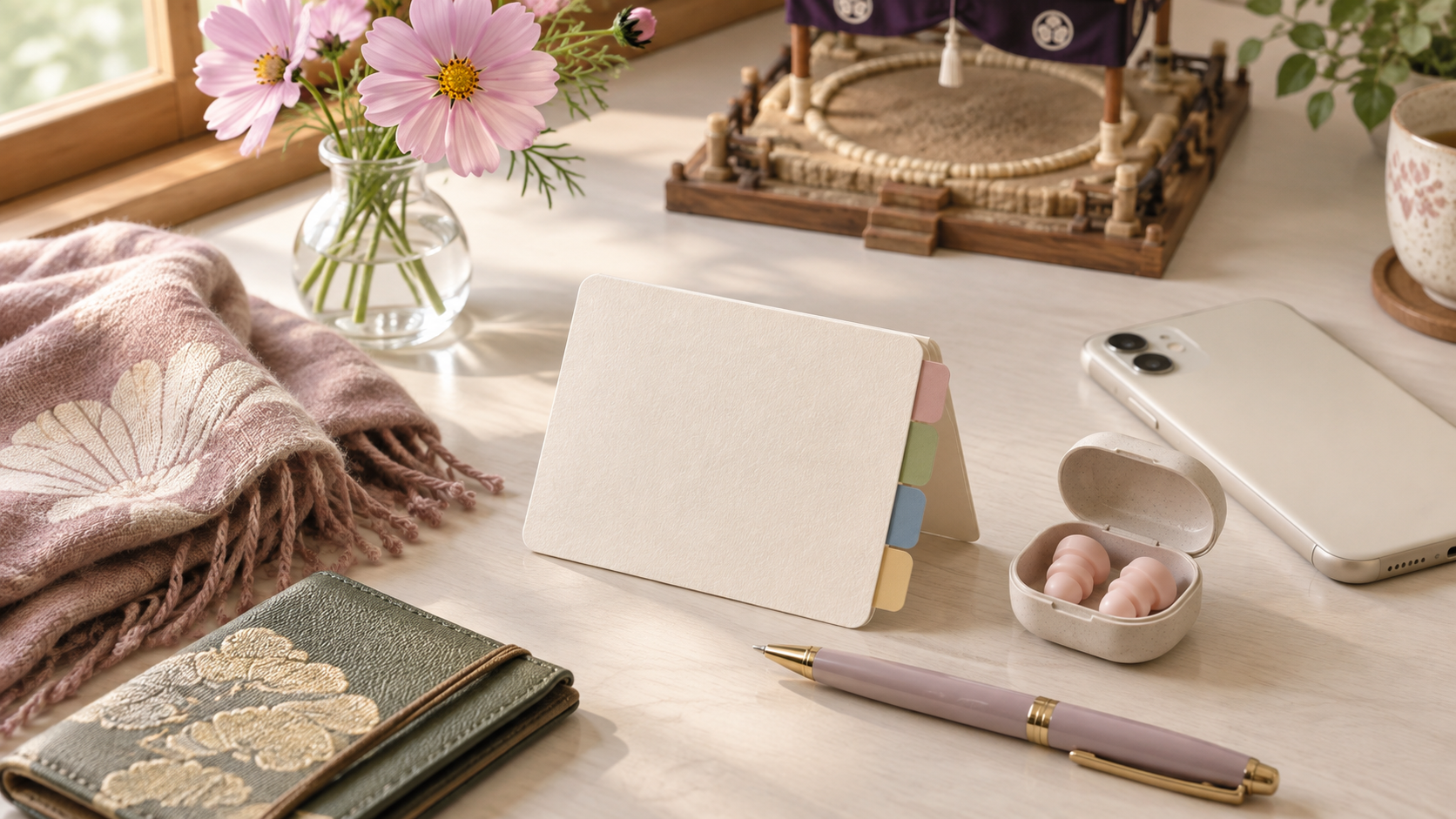
If you may need to step away from noise, light or crowds at Ryogoku Kokugikan, do not build the day around a dedicated quiet room. The official September 2026 information we reviewed does not confirm a sensory room, low-stimulation area or guaranteed quiet space. Instead, carry one short card with your likely triggers, a sentence to show staff, the conditions for taking a break or leaving, and a second way to receive emergency information. Ask what is actually available as soon as you enter.
Our broader sensory-overload plan helps you choose a shorter visit and a personal signal. This guide turns that plan into something you or a companion can still use when conversation and decision-making have become difficult.
Give the card four boxes
A phone note or a small piece of paper is enough. Use four headings:
- What may become difficult: only the sound, visual input, crowding or overlapping communication relevant to you.
- What normally reduces input: a familiar strategy or device, plus any condition under which it must be removed or stopped.
- What to tell staff: for example, “I need to step away from the seating area and reduce sensory input. Where should I go?”
- What happens next: pause inside, finish the visit, or seek urgent assistance.
You do not need to place a diagnosis or full medical history on the card. Decide what a companion may share. If you have individual medical instructions, those take priority over an article or a generic checklist.
Ask two questions, not one vague question
After admission, show your ticket and seat number and ask separately:
- Where may a ticket holder temporarily leave the seating area without blocking circulation or other spectators?
- Where is the nearest staffed point if you become unwell, lost or unable to receive an announcement?
Do not name a lobby, lounge or break area in advance and assume it will meet your needs. A place may exist without being quiet, seated, uncrowded or open for the entire tournament day. This page cannot promise privacy, silence or unrestricted access.
Do not make repeated outdoor breaks the only plan
The September 2026 spectator notice permits re-entry once per day. Going outside cannot be treated as a reset button you may use repeatedly. Before leaving the building, ask gate staff how the process applies to your ticket and whether you need to retain a paper stub or follow a particular QR procedure. “I am done for today” should remain a valid branch of the plan.
The same notice asks spectators to avoid moving between seats during a bout. When you safely can, use the end of a bout as a natural point to gather your belongings and leave the row. That etiquette is not a requirement to endure acute distress. Ask for room and follow staff instructions when safety or health requires immediate movement.
Put the break before the one moment you want
The Association’s Tokyo timetable lists lower-division bouts, the juryo and makuuchi ring-entering ceremonies, a possible yokozuna ring entry, and the closing bow ceremony. Times are approximate, and the timetable does not establish when the building will be quiet. It still lets you choose one anchor—perhaps one complete makuuchi ring-entering ceremony—and protect some capacity for it.
Take a planned break while you can still choose calmly, rather than waiting for a crisis. With a companion, agree that one word such as “pause” or “leave” starts the next action without a debate. The support-person day plan covers roles, while our hearing and visual information plan helps create a second route for announcements.
Receive one drop, not the whole arena
If you return to your seat, do not try to catch up with everything you missed. In one bout, wait only for the brief space after the yobidashi has finished calling the two names. The arena may not become silent, but attention changes shape around the dohyo. Finding that tiny change can make a dense sensory field feel more legible.
If you do not return, the day is not invalid. The card protected enough capacity for another attempt. Our early-departure plan helps connect a shortened visit to a realistic journey home.
Separate rest, return and leave by a body signal
Confirmed fact: September guidance allows one re-entry and asks spectators to avoid moving during bouts.
What remains unknown: The checked official material does not confirm a place that is always quiet, private, seated and available.
Reasoned inference: Comparing the timetable with one re-entry suggests that resting one segment before the desired moment preserves more options than waiting until it starts. This covers planning margin, not quietness or recovery. Live progress and personal medical advice override it.
Editorial suggestion: Before speech becomes difficult, share three words—rest, leave, staff—and the location of familiar medication, hearing protection or water with a companion. This is not medical advice or an arena rule.
Fallback: Do not wait for the next bout. Tell staff briefly and leave the seat; if the intended space is unavailable, switch to another staff point, outside or home.
Sources
- Japan Sumo Association, September 2026 Tokyo spectator notice, checked September 3, 2026, for the one-time re-entry rule, QR tickets and movement during bouts.
- Japan Sumo Association, Tokyo ring schedule, checked the same day as a programme guide rather than a promise of noise or crowd levels.
- Japan Sumo Association spectator contract, checked the same day for assigned seating, circulation areas and staff instructions.
- No sensory room, quiet room or low-stimulation section is promised because none was confirmed in the official material reviewed.
Source links used for verification
Each link was used for the corresponding claim in this article; inclusion is not a blanket endorsement of the whole page.
Article verified:
- Japan Sumo Association September 2026 Tokyo spectator noticePrimary source (as checked for this article)
- Japan Sumo Association Tokyo tournament ring schedulePrimary source (as checked for this article)
- Japan Sumo Association spectator contractPrimary source (as checked for this article)