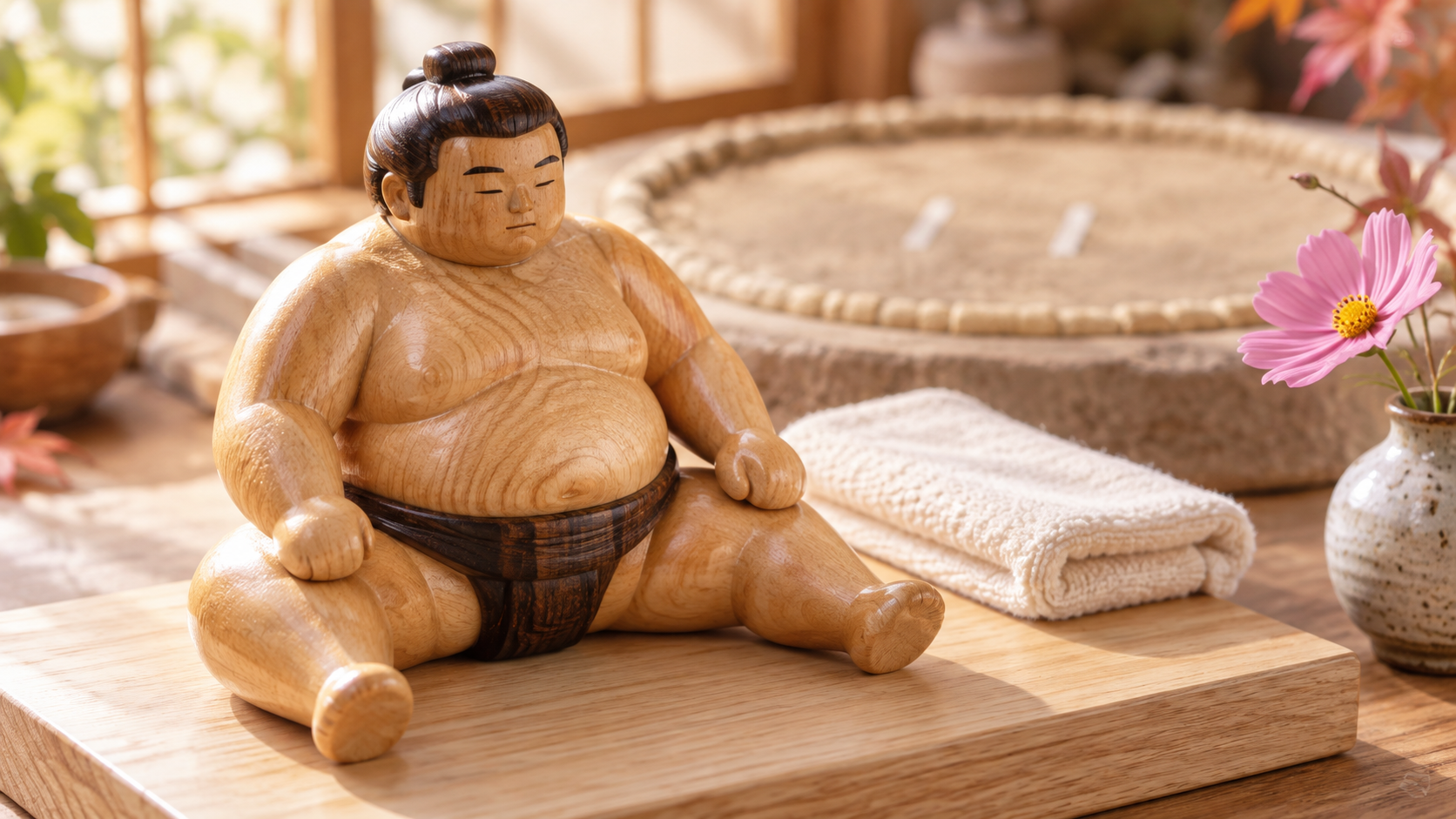
Matawari is a sumo flexibility movement in which the legs open widely and the body lowers. A Japan Sumo Association youth teaching report describes participants patting the thighs and bringing the abdomen toward the ground, placing flexibility in an injury-prevention context. Watch the gradual approach to the position, not only the most dramatic final depth.
A photograph of a large wrestler placing the upper body near the floor is instantly striking. Do not turn it into the challenge “Can I force myself that low?” The image records supervised practice; this article does not present that depth as a target or a one-attempt instruction.
What the Association reports support
The stable open-day report shows matawari, side stretching and instructors assisting young participants. A separate seminar report depicts oyakata and active instructors teaching adult trainees.
These primary photographs support a careful statement: matawari appears in sumo instruction and is described in relation to maintaining flexibility and preventing injury. They do not establish one compulsory angle, duration, progression or pain threshold for every wrestler. We do not fill those missing details with invented numbers.
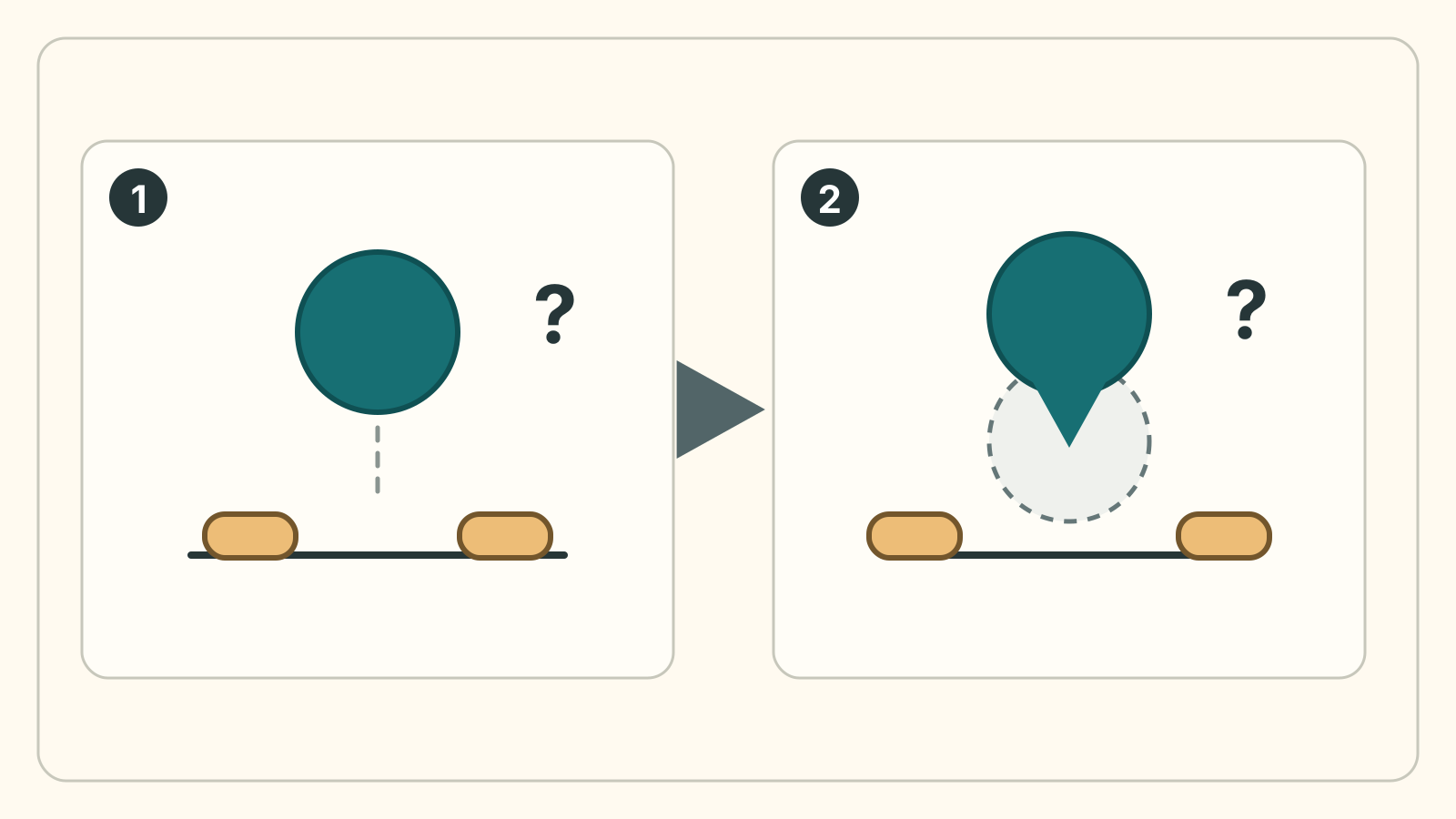
Detailed description of this diagram
The left card places a blue state token between two gold support tokens and uses a question mark to leave spacing and body geometry unresolved. The right card moves from an upper blue state to a lower dashed state, preserving only the documented gradual direction. Spacing, vertical distance and circle size encode no legs, pelvis, abdomen, joint angle, flexibility, contact point, pressure, pain, time, repetitions, target depth or self-training method.
Graphic: SUMO ARCHAEOLOGY CLUB · Figure source 1 · Figure source 2
Look beyond how far the legs open
During observation, note the speed of entry, differences between sides, the coach’s assistance and the choice to pause. Breathing cannot always be judged from a photograph or distant seat, so do not pretend to see it. This keeps the deepest position from becoming a ranking of people.
Connect matawari to other basics rather than treating it as a circus display. Shiko transfers the body’s weight onto one supporting leg. Suriashi carries a low stance across the ground. In a bout, a wrestler may need to preserve position while the legs spread under pressure. Flexibility is part of a moving system, not an isolated photograph.
Keep a firm boundary around imitation
This article is not medical advice, flexibility programming or a procedure for reaching the photographed depth. It does not recommend having another person force the torso down, bouncing into the range or continuing through pain. Anyone who wants to practise should work with a qualified instructor who can assess the individual, and seek appropriate clinical advice when pain, injury or a health condition is involved.
The next time you watch matawari, look one breath before the deepest position. There is often a quiet moment in which the body is prepared for what comes next. It reveals something easy to miss in tournament highlights: sumo strength is built not only in explosive movement, but also in patient control before movement begins.
Observation note
- Speed of entering the position
- Breathing and side-to-side difference
- Instructor assistance
- Depth not treated as the only achievement
- No painful or forced self-imitation
Return from a Label to the Next Observable Action
Do not reduce a person to body size, age, nationality, hometown, school or role title. Follow a hand position, task, bout sequence or official record in the next appearance instead. An attribute can start a question; it is not a conclusion about character, strength or future.
Sources
- Japan Sumo Association, youth stable open-day and instructor-seminar photo reports, checked September 3, 2026.
Source links used for verification
Each link was used for the corresponding claim in this article; inclusion is not a blanket endorsement of the whole page.
Article verified:
- Japan Sumo Association youth stable open-day photo reportHistorical primary source (record from that period)
- Japan Sumo Association instructor seminar photo reportHistorical primary source (record from that period)