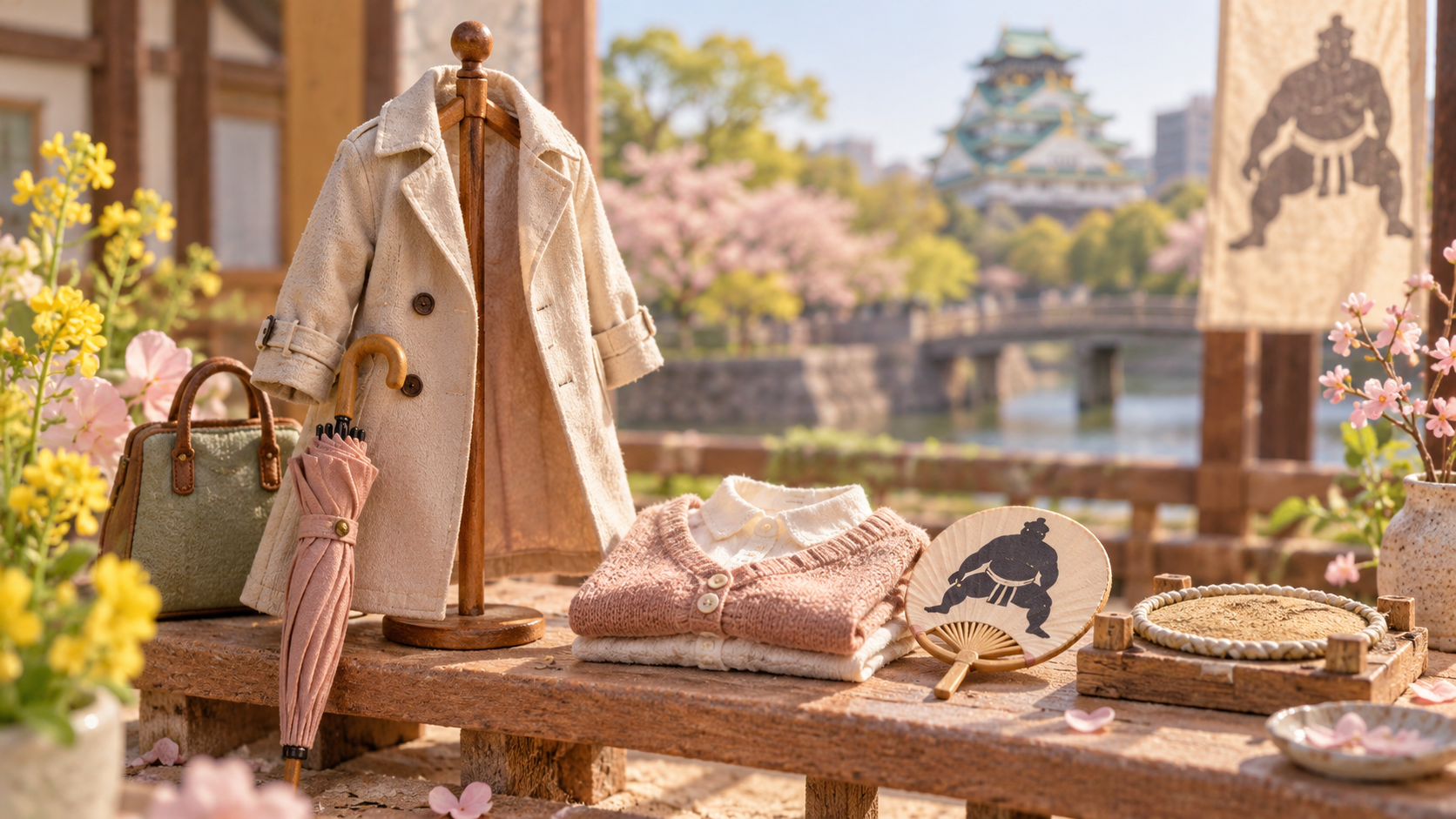
Do not dress from the idea that Osaka in March is automatically warm. Check the Japan Meteorological Agency forecast shortly before your visit and build three adjustable layers: a comfortable base, a middle layer you can open or remove, and an outer layer for the forecast wind or rain. Climate normals describe the season, not the high and low on your ticket date. Cover both an early arrival and the evening exit.
A walk from Namba may look short, yet entry queues, traffic lights and crowds can extend the outdoor period. Inside, a heavy coat becomes another object in a limited seat area. The useful outfit is not the warmest one; it is the one you can change without reorganising your entire masu box or disturbing the chair beside you.
Use three layers rather than one prediction
Choose a base that remains comfortable if you perspire, a middle layer that can be adjusted while seated, and an outer shell matched to the current forecast. There is no need for a specialised or expensive “sumo outfit.” Test whether the outer layer folds into your bag instead of spreading into another spectator’s space.
In a masu box, items on the floor directly affect posture. A chair seat also has no magical coat storage. Do not assume the venue will hold clothing or luggage merely because the building has general-purpose facilities.
Check at three moments
Read the JMA area forecast the evening before, review hourly temperature and precipitation in the morning, and check rain or transport information again before leaving the arena. A photograph from a previous March records one day, not a reliable wardrobe rule.
If rain is expected, choose an umbrella that can be managed in an entrance crowd and bring your own simple bag for the wet item. Do not assume that umbrella covers will be distributed. Visitors who need lifts or step-free routes should reopen the station map because the driest or shortest exit may not be the accessible one.
Clothing should disappear from your attention
When you are too cold or too warm, your body becomes louder than the dohyo. Make one adjustment before the next division, then watch a single moment when a wrestler’s foot leaves the clay. Preparing your own comfort is not separate from appreciating sumo; it preserves the attention that lets a tiny movement become exciting.
Fallbacks for a forecast that changes
If the morning is colder than expected, use the layers already with you before buying a special item; close or add one layer and reassess after the next indoor transition. If it becomes warmer, remove one layer and store it inside your own bag or seat space rather than spreading it into an aisle. The venue has not been confirmed here as a coat-storage fallback.
If heavy rain, a warning or transport disruption appears, shorten the outdoor route or change the visit plan according to current official advice. Clothing cannot turn a dangerous journey into a safe one. The conservative fallback may be arriving later or not travelling, even when a ticket exists.
Evidence limits and event-day fallback
Confirmed fact: JMA Osaka normals show a seasonal range and forecasts provide a nearer-date outlook. Normals are not event-day temperature, and venue pages do not guarantee an individual’s indoor comfort.
What remains unknown: Actual temperature/rain/wind/warnings, outdoor queue, indoor feel, umbrella bag/storage, transport and personally suitable clothing, hydration and stay length remain live conditions.
Reasoned inference: Three removable layers and a packable outer layer are likely to adapt better across morning, arena and return than one forecast outfit. Confidence is medium; this guarantees neither comfort nor health.
Editorial suggestion: Test an ordinary outfit adjustable while seated and recheck primary information the night before, morning and before exit. This is not medical or venue instruction.
Fallback: If warning, disruption, severe heat/cold, pain or unsteadiness breaks the plan, reduce outdoor waiting, rest, arrive later, leave early or stop; seek appropriate professional help for symptoms.
Sources
- Japan Meteorological Agency, Osaka climate normals and forecast service (checked 3 September 2026; recheck immediately before the visit).
- Japan Sumo Association, Osaka tournament information, and EDION Arena Osaka access page (checked 3 September 2026).
Source links used for verification
Each link was used for the corresponding claim in this article; inclusion is not a blanket endorsement of the whole page.
Article verified:
- Japan Meteorological Agency Osaka climate normalsPrimary source (as checked for this article)
- Japan Meteorological Agency forecastsPrimary source (as checked for this article)
- Japan Sumo Association Osaka tournament informationPrimary source (as checked for this article)
- EDION Arena Osaka accessPrimary source (as checked for this article)