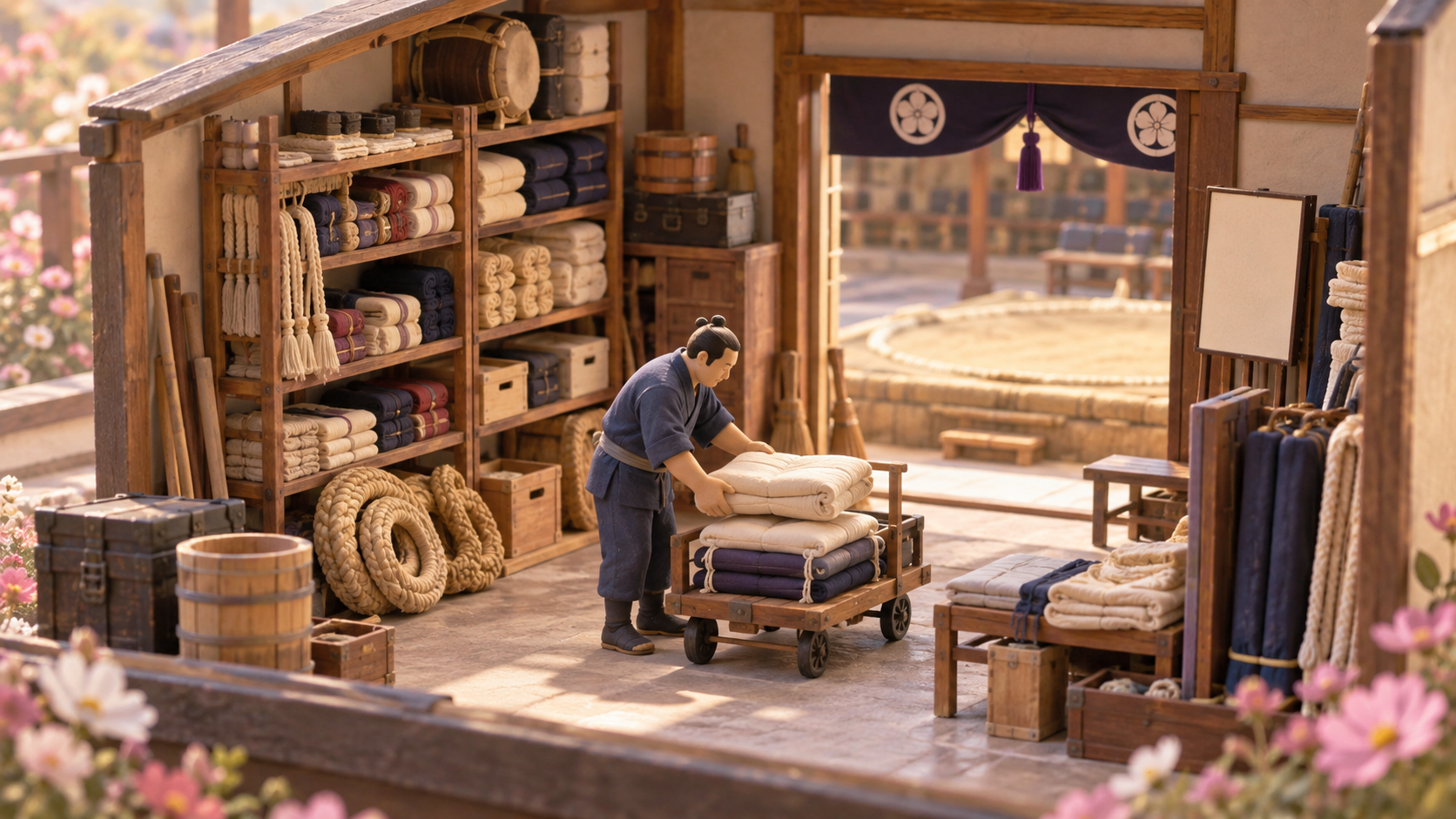
A sewanin is a Japan Sumo Association member whose formal duties include transporting, storing and otherwise managing sumo competition equipment, along with other tournament work. It is not one narrowly defined task. Sewanin help connect the physical systems that allow a basho to keep moving.
The arena scoreboard can look automatic from a seat. An Association feature about the Nagoya tournament shows something more interesting: name panels are rearranged for the next day, and a person follows the bouts carefully to illuminate each result. Even the display furthest from the clay contains human attention.
The role in the Association’s rules
Article 51 of the Association’s articles of incorporation establishes sewanin as Association members. It identifies management of competition equipment—including transport and storage—as a central responsibility, while leaving room for other work connected with sumo competition.
The ordinary meaning of the Japanese word can be “caretaker,” which creates an easy translation mistake. A sewanin is not a tsukebito caring for an individual sekitori. A tsukebito is an active lower-ranked wrestler. A sewanin is an Association role supporting the sport and its operations.
A scoreboard offers one visible example
Official Association features document sewanin working with the electronic scoreboard at the Nagoya venue. After the day’s bouts, the panels bearing ring names are replaced to match the next day’s schedule. During competition, lights are activated as results are confirmed.
This evidence has a clear scope: it is a documented Nagoya task, not proof that every venue uses the same mechanism or that every sewanin performs it every day. The example helps us see the broad equipment-and-event definition without turning one photograph into a universal job description.
Our description of the display as “human attention” connecting two days is an interpretation, not an official technical account. The sources do not tell us how much is automated, how many people verify a change or whether another venue works differently. A contrary mechanism elsewhere would limit the metaphor rather than disprove the dated Nagoya example.
Former ring names remain on the directory
The current official sewanin directory lists a person’s active-era ring name, real name, highest rank and stable affiliation. Unlike an elder who assumes a toshiyori name, a sewanin is displayed through the shikona familiar from his wrestling career.
The directory checked includes former wrestlers with highest ranks in juryo and makushita. That describes the people currently displayed; it is not a complete historical range or a recruitment rule. Highest rank also cannot be used to grade a person’s present duties or skill.
How is this different from a wakaimonogashira?
The formal centre of a wakaimonogashira’s job is supervision of wrestler trainees in makushita and below. The formal centre of a sewanin’s job is management of competition equipment. Both descriptions also allow wider competition-related assignments.
A spectator should not label a worker from appearance alone. The valuable distinction is structural: one role is anchored in developing lower-ranked wrestlers; the other is anchored in keeping the equipment and event machinery ready.
Do not identify an assignment from appearance
The sources do not tell us who is assigned to a particular task on a particular day. Seeing someone handle equipment is not enough to establish a title, a name, or permission to watch or photograph the work. Record “role unknown” unless a same-day official source resolves it.
From your normal spectator position, comparing one visible scoreboard panel with the next day’s official schedule can be a satisfying detail to notice. This is our viewing suggestion, not permission to enter a work area, interrupt staff or photograph an individual.
When verification stops, the safe alternative is not to invent the missing name. Keep the formal duty and dated example, label the individual or current assignment unknown, and leave that gap visible. The trail of what we checked remains useful even when it does not end in a personal identification.
Imagine the scoreboard changing after you leave
At your next tournament, choose one ring-name panel on the scoreboard. The dated Nagoya feature shows that panels were prepared for the next day after spectators departed; do not assume that exact procedure at every arena.
That thought stitches fifteen tournament days together. The basho is not fifteen separate performances that materialise each morning. Work continues in the quiet interval, and a former wrestler may now be carrying the next day into place one panel at a time.
Sources
- Japan Sumo Association, articles of incorporation, Article 51 (checked 4 September 2026)
- Japan Sumo Association, sewanin directory (checked 4 September 2026)
- Japan Sumo Association, Sumo Quiz No. 168 (published 25 June 2022; checked 4 September 2026)
- Japan Sumo Association, Sumo Quiz No. 887 (published 13 June 2024; checked 4 September 2026)
Source links used for verification
Each link was used for the corresponding claim in this article; inclusion is not a blanket endorsement of the whole page.
Article verified:
- Japan Sumo Association articles of incorporationPrimary source (as checked for this article)
- Japan Sumo Association sewanin directoryPrimary source (as checked for this article)
- Japan Sumo Association Sumo Quiz No. 168Historical primary source (record from that period)
- Japan Sumo Association Sumo Quiz No. 887Historical primary source (record from that period)