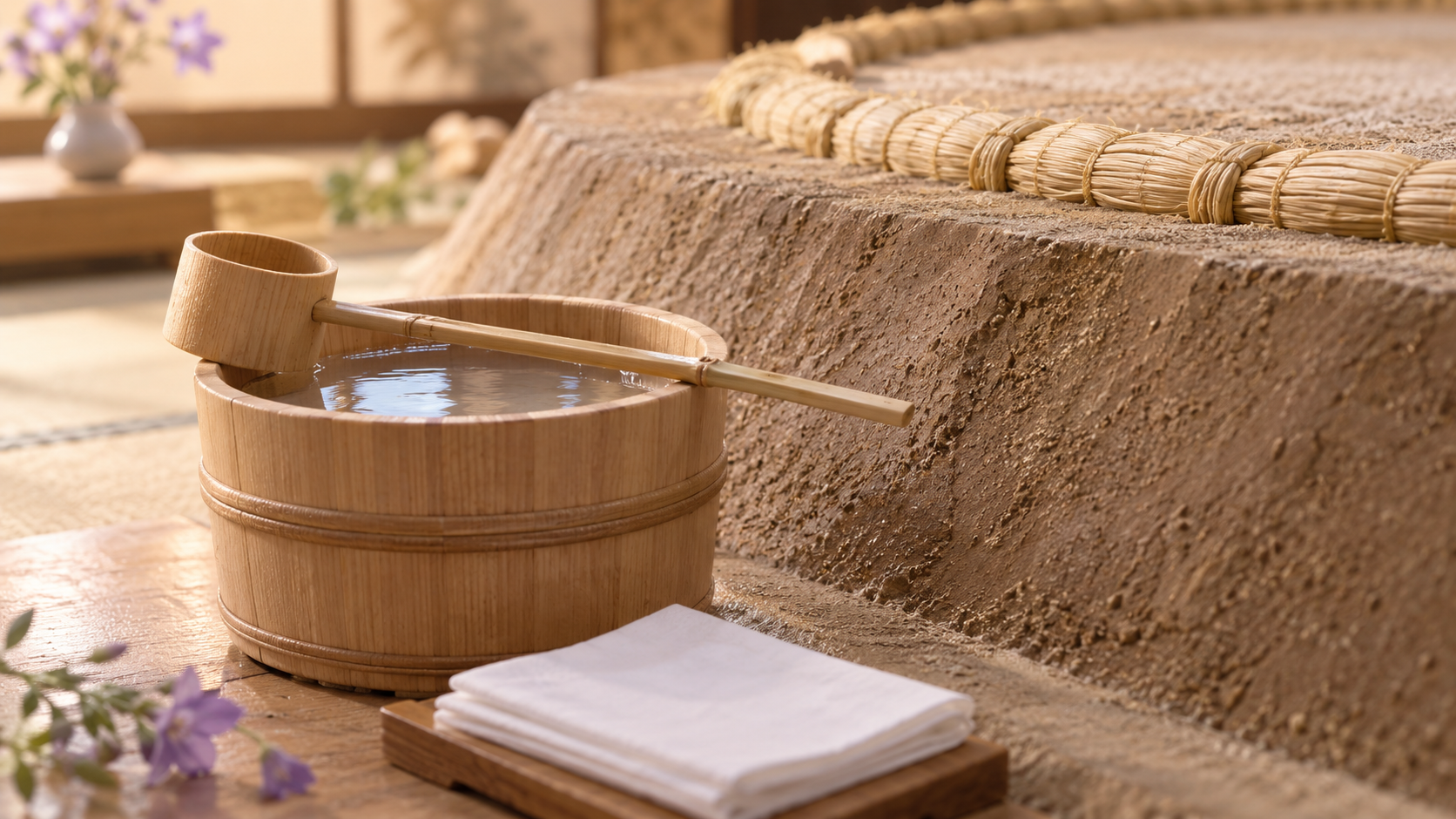
A *mizu-iri*, literally a “water break,” may pause a long juryo or makuuchi bout when the wrestlers have become locked in a stalemate. The gyoji stops the action with the judges’ agreement. The wrestlers leave the ring, take water, retighten their belts and rest; then their previous foot positions and grips are reconstructed before the same bout continues. It is neither a new bout nor an automatic draw.
Most televised sumo contests are over within seconds. When two wrestlers settle into an immovable belt grip and the picture remains almost still, a first-time viewer may wonder whether something has gone wrong. In fact, the stillness is part of the contest. If a water break is called, the dated Association explainers describe a pause followed by restoration of feet and grips. They do not disclose a fatigue measurement or the method and precision used to record every position.
Who stops the bout?
The Japan Sumo Association explains that the timekeeping judge signals when a bout has run long and become deadlocked. The gyoji obtains the other ringside judges’ agreement and tells the wrestlers to wait. One official explanation mentions roughly four or five minutes as a guide, but viewers should not treat that as a countdown that mechanically triggers a break. The officials assess the actual state of the bout.
Just before the stop, try to remember only two details: the location of one wrestler’s leading foot and which hand holds the opponent’s belt. You do not have to decide who is winning. Those two details will make the restoration visible when everyone returns.
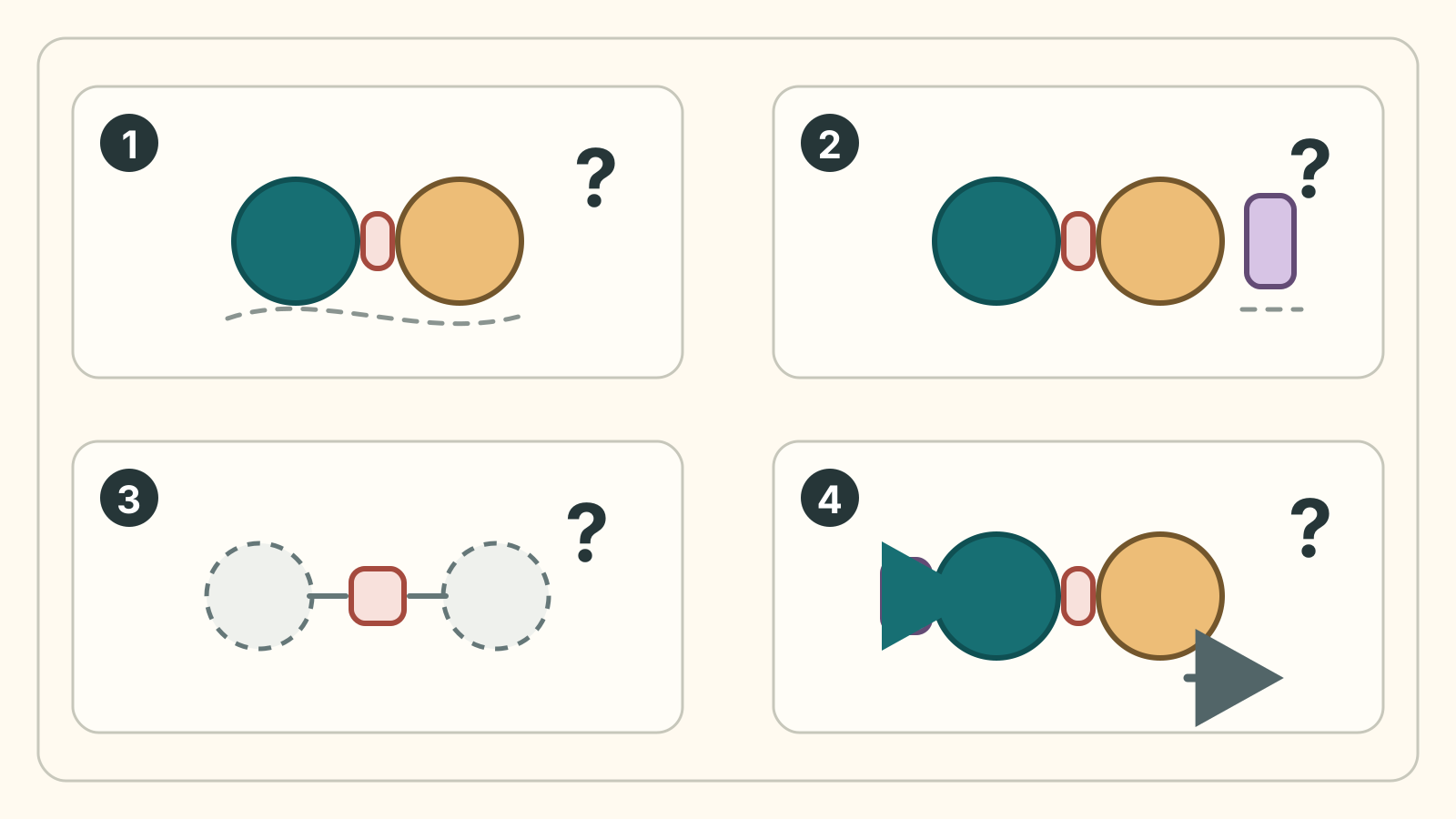
Detailed description of this diagram
Card 1 uses two related tokens and a question mark to withhold any spectator test for mizu-iri eligibility. Card 2 adds a purple official-role token to the pause. Card 3 uses two dashed tokens and a central relation fingerprint only to stand for reconstruction of the interrupted feet and grips. Card 4 restores the relation and adds an official cue plus a shared continuation arrow. It encodes no actual foot location, grip, posture, rest duration, water quantity, spoken or hand cue, judge placement or outcome.
Graphic: SUMO ARCHAEOLOGY CLUB · Figure source 1 · Figure source 2 · Figure source 3
Leaving the dohyo does not end the contest
The wrestlers step down, take water, have their mawashi tightened and recover. This water is part of the special pause, not simply the ordinary pre-bout ritual in which a wrestler receives *chikara-mizu*, or “power water.” Our separate guide to chikara-mizu explains that routine.
A mizu-iri does not declare a withdrawal, a draw or a winner. Crowd noise may rise while the ring is empty, but the original contest remains unfinished. Think of the break as a carefully placed bookmark rather than the end of a chapter.
Reconstructing the feet and grips
Before the restart, the gyoji puts the wrestlers’ feet and belt grips back into the positions held at the stoppage. The ringside judges check the reconstruction, and the wrestlers have the opportunity to object if something is wrong. According to the Association, the gyoji then asks *ii ka, ii ka*—approximately “ready?”—and taps both wrestlers’ mawashi simultaneously to restart the action.
That reconstruction is the heart of the procedure. The Association says the wrestlers rest and that feet and grips are restored before the same bout resumes. A spectator cannot measure the amount of recovery or precision of restoration; comparing one visible foot or grip is an observation of the procedure, not a biomechanical assessment.
Mizu-iri is not a rematch
A *torinaoshi* is a complete rematch ordered after the first contest is judged too close to award. The wrestlers prepare again and begin from a new tachiai. After mizu-iri, by contrast, no result has yet been reached. The officials restore the interrupted position and continue from there.
A new approach to shikiri, versus restoration of the interrupted feet and grips, can be a viewing clue. It is not a substitute for a case-specific ruling: if the sequence is off-camera or unclear, wait for the arena explanation and official result.
One detail to watch next time
Water breaks are unusual, so failing to see one is not missing an essential part of every sumo day. But if a long stalemate develops, choose one foot and one gripping hand before the officials intervene.
When the wrestlers return, watch the gyoji rebuild those two points and listen for *ii ka, ii ka*. A pause that initially looked like empty time becomes an exercise in preserving a living contest. You may even find yourself wishing the camera would hold on the hands for another second—not because you want the bout to stop, but because you now want to see how precisely it can begin again.
Evidence limits and event-day fallback
Confirmed fact: Association explainers from 2023/2024 describe a long, deadlocked juryo-or-above bout: the timekeeper signals, the gyoji obtains judges’ agreement, pauses it, then restores feet/grips after rest, checks and resumes the same bout.
What remains unknown: No fixed current threshold, case-specific reason, recording method, restoration accuracy, rest duration, water quantity, amount of recovery, fatigue, pain or every exception is established by those dated pages. Four or five minutes is not an automatic trigger.
Reasoned inference: Treating the pause as a bookmark and comparing one foot/grip before and after may make the procedure legible. Confidence is medium; it does not assess advantage, biomechanics or exact restoration.
Editorial suggestion: Watch one point before the pause and the gyoji/judges’ check at restart. Do not infer the reason or physical condition, and separate a dated general explainer from the arena account of this bout.
Fallback: If the pause, restart or distinction from torinaoshi is hidden, do not apply a shortcut as a ruling; wait for the arena/broadcast explanation and official result, following it as the same bout until resolved.
Sources
- Japan Sumo Association quizzes No.817, No.695 and No.493 (verified 3 September 2026).
Source links used for verification
Each link was used for the corresponding claim in this article; inclusion is not a blanket endorsement of the whole page.
Article verified:
- Japan Sumo Association quiz No.817: mizu-iri procedureHistorical primary source (record from that period)
- Japan Sumo Association quiz No.695: restarting after mizu-iriHistorical primary source (record from that period)
- Japan Sumo Association quiz No.493: bouts eligible for mizu-iriHistorical primary source (record from that period)