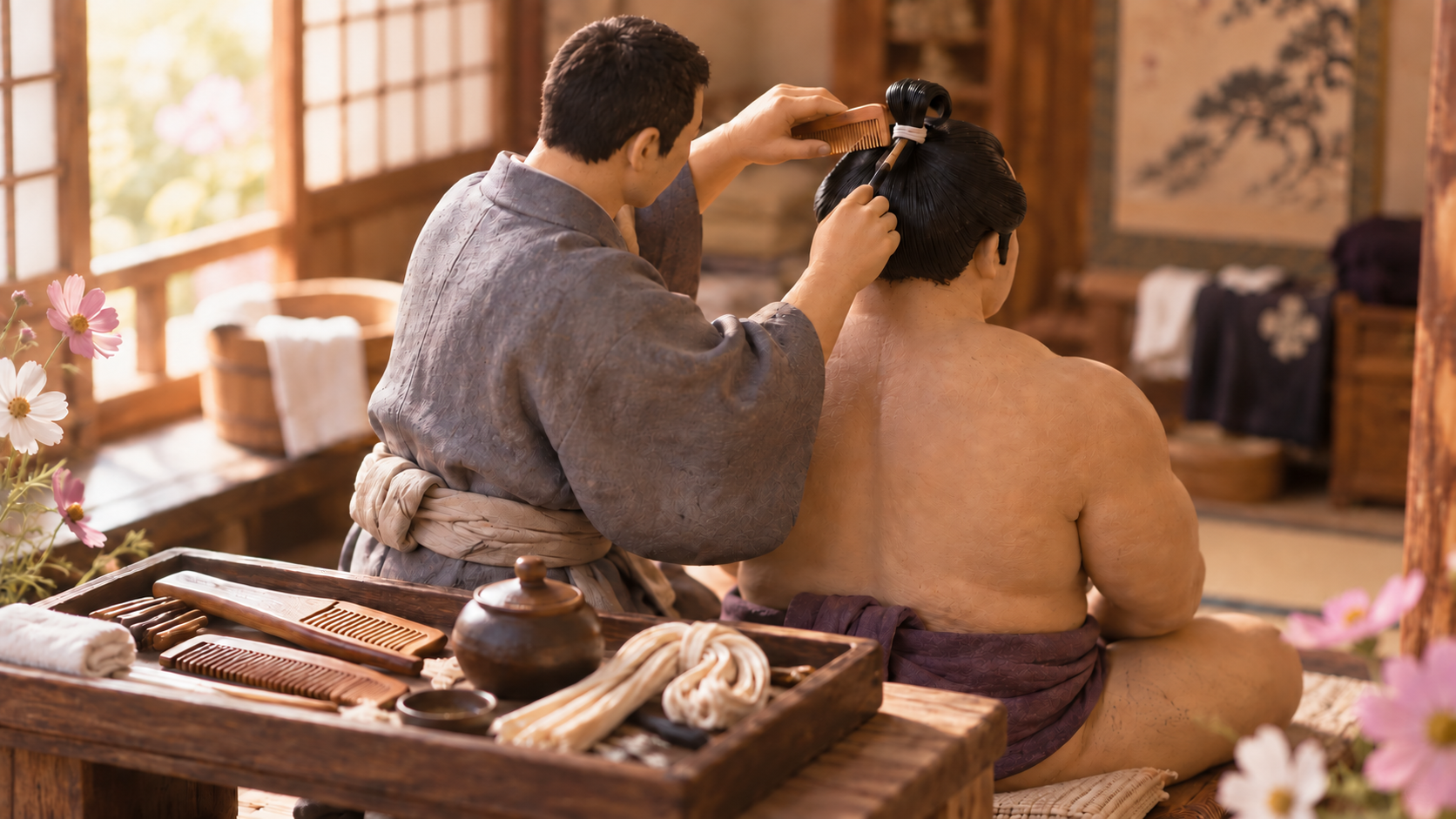
The Japan Sumo Association directory and FY2025 activity report show six tokoyama grades: fifth, fourth, third, second, first and special class. When checked on 3 September 2026, the directory listed professional name, real name, grade and stable affiliation. It does not, by itself, identify each wrestler assignment, years of training or the relative quality of an individual’s work.
The broad oicho topknot is easy to admire during a ring-entering ceremony. The person who built its balanced shape is much harder to see. Open the official directory once, however, and another set of names appears behind the wrestlers. Following a favourite rikishi can lead you to the craftsperson who cares for one of sumo’s most recognisable forms. That extra human connection is the point of learning the grades—not turning artistry into another table to memorise.
The ladder runs from fifth class to special class
An official Association feature describes the sequence clearly: fifth, fourth, third, second and first class, followed by special class at the top. The Association’s FY2025 activity report records tokoyama numbers in all six grades as of the end of that calendar year. This is a formal grading structure, not an unofficial fan ranking of the best hairstyles.
It is tempting to map the six steps directly onto the wrestlers’ banzuke. The official feature itself uses a comparison with the lower divisions to make the ladder approachable, but the systems are not identical. A wrestler’s rank normally changes with tournament results. The tokoyama schedule described in the activity report follows a different cycle.
Nor should a current grade be used to review an individual’s work from a photograph. The directory tells us grade and affiliation; it does not identify who tied every wrestler’s hair on every date. Unless a caption or other official record credits a particular tokoyama, we do not attach a finished oicho to a person by guesswork.
Grades are normally set for the following year
The FY2025 report says that tokoyama grades are, in principle, decided by the Association’s board after the September tournament for the following year. That is very different from the six-tournament rhythm familiar from wrestlers’ promotions and demotions.
If a tokoyama’s grade appears different in two pages published months apart, first check their dates. An older page can be an accurate historical snapshot without describing the current roster. This article therefore does not freeze the name of the highest-ranked active tokoyama into the body. The live directory is the source for the current person and grade.
That distinction also makes the role more interesting. A topknot is a visible result on one particular day, yet the career behind the hands is evaluated over a much longer span. The finished line appears all at once to a spectator; the professional ladder takes years.
Training connects the stable and the specialist group
The same official report gives us a rare, careful view of training without inviting fiction about private routines. It says that the stablemaster is responsible for developing tokoyama in third class and below, while members of the tokoyama committee provide the practical instruction required for the profession.
Two structures meet here. The hairdresser belongs to a heya, the stable that forms sumo’s everyday organisational unit. At the same time, specialist knowledge is passed through people responsible for the craft itself. We can say that much from the report. We cannot turn it into a universal hour-by-hour apprenticeship, state how many wrestlers each person styles, or claim that every stable has exactly one tokoyama. Those details are not established by the cited sources.
Newly recruited tokoyama also receive sumo-history instruction through the training school. That shared classroom element sits alongside the role-specific practical instruction described above. The stable, the profession and the wider Association are therefore all visible in the way the work is developed.
Grade does not create a simple oicho licence
An Association quiz published on 16 May 2025 said, as a dated official explanation, that no rule set a minimum tokoyama grade for tying an oicho. It also described learning the technique as taking years, but did not give one guaranteed duration for everyone. The archived explainer is not a complete current assignment rule; current internal practice remains unconfirmed without a present rule or attributed official statement.
The safe distinction is between the documented grade system and the dated statement that the task had no minimum-grade rule. Neither source establishes who may be assigned to a particular wrestler today, and it does not mean a beginner can immediately perform the task. Our separate oicho guide checks wearer and tool claims against its own sources rather than importing them from this archive.
This is also a good defence against a common internet shortcut. Do not identify a hairdresser’s grade merely because a video shows them tying a sekitori’s hair. Check the official directory instead.
How to find one tokoyama without inventing a connection
Start with a wrestler’s current official profile and note the stable. Then open the Association’s tokoyama directory and search for that stable name. The result shows publicly documented affiliations, not a guaranteed one-to-one assignment. If no matching listing appears, do not conclude that the stable has no access to a hairdresser or make up an arrangement. Stop at what the directory establishes.
At the next dohyo-iri, watch your wrestler turn. Look once at the oicho’s two clean wings and the rounded section resting on the crown. Somewhere before that entrance, trained hands transformed everyday hair into that formal outline. You may not see the craftsperson in the shot, but now the work has a profession, a career ladder and a place in the stable system.
Sumo rewards attention in this way. A single wrestler leads to a stable; a stable leads to a tokoyama; a topknot leads to years of training. You began by watching who wins, and suddenly there is another person to care about before the bout even starts.
Sources
- Japan Sumo Association, tokoyama directory (checked 3 September 2026)
- Japan Sumo Association, FY2025 activity report (checked 3 September 2026)
- Japan Sumo Association, Sumo Quiz No. 664 (published 3 November 2023; checked 3 September 2026)
- Japan Sumo Association, Sumo Quiz No. 1224 (published 16 May 2025; checked 3 September 2026)
Source links used for verification
Each link was used for the corresponding claim in this article; inclusion is not a blanket endorsement of the whole page.
Article verified:
- Japan Sumo Association tokoyama directoryPrimary source (as checked for this article)
- Japan Sumo Association FY2025 activity reportPrimary source (as checked for this article)
- Japan Sumo Association Sumo Quiz No. 664 on the highest tokoyama gradeHistorical primary source (record from that period)
- Japan Sumo Association Sumo Quiz No. 1224 on grades and the oichoHistorical primary source (record from that period)